"Pulpit Rock on Presque Isle," Lake Superior near Marquette, Michigan, 1898. / THF118818
The border between the United States and Canada runs through four of the five lakes that constitute the world’s largest freshwater system—the Great Lakes. Policy makers on both sides of this fluid border have agreed to protect access and use of these bodies of water and their bays, arms, and inlets for more than 100 years.
View from the Harbor, Petoskey, Michigan, circa 1906. / THF118856
In the Boundary Waters Treaty of May 5, 1909, the United States and Great Britain (speaking for its Dominion of Canada) agreed to ensure free access and shared use of the navigable waterways. This sustained lucrative transportation and trade networks that the locks at Sault Ste. Marie, Michigan, helped facilitate.
Photochrom Print, "The Locks, Sault Ste. Marie, Michigan," 1905. Ships moved between Lake Superior and Lake Huron via these locks. / THF113687
The Boundary Waters Treaty of 1909 also stressed the shared responsibility for protecting water quality. Specifically, the United States and Great Britain “agreed that the … boundary waters … shall not be polluted on either side to the injury of health or property on the other” (Article IV).
Man Drinking from Flowing Well, Wequetonsing, Michigan, circa 1906. / THF119004
Increased populations, however, created problems that the partners had to solve. The treaty called for a six-person International Joint Commission (IJC) to mediate or investigate issues that arose. When cholera outbreaks increased in 1912, the IJC launched a comprehensive study of the boundary waters. Research conducted over five years confirmed that untreated water polluted with raw sewage carried bacteria that caused cholera and typhoid. Findings affirmed transnational responsibility for protecting public health and drew attention to the need for communities to ensure drinking water purity. You can read the final report from 1918 here. And this work continues, as “The Great Lakes Water Quality Centennial Study – Phase 1 Report” (2021) underscores.
Industrial pollution, especially the release of manufacturing waste into boundary waters, further increased the sense of urgency to maintain Great Lakes water quality.
View from Incline Railway, Duluth, Minnesota, circa 1908. / THF119376
Beautiful postcards, like this illustration of the bridge over the Mackinac Straits, could not compete with the evidence of growing Great Lakes degradation.
Postcard, Mackinac Straits Bridge, circa 1957 / THF144098
Growing public concern over industrial pollution found an outlet in Earth Day, April 22, 1970. That same year, the IJC released a report that stressed the “grave deterioration of water quality” in the Great Lakes, drawing on the Boundary Waters Treaty of 1909 as precedent for reaffirming the rights and obligations of both parties to not pollute boundary waters.
On April 15, 1972, representatives from Canada and the United States signed the Agreement on Great Lakes Water Quality. The two countries pledged to restore and enhance water quality in the Great Lakes. This included general objectives to keep the boundary waters free from substances that result from human activity and that might negatively affect aquatic life or waterfowl, be toxic or harmful to humans, or create a nuisance, including concentrations that could encourage aquatic weeds or algae. The agreement also itemized specific water quality objectives and targets around controlling phosphorus and monitoring vessel design, construction, and operation, as well as vessel waste and other forms of shipping pollution. It specified procedures for handling polluted dredged spoil (the waste material produced by dredging) and discharge of pollutants into boundary waters. You can read this 1972 agreement here.
April 15, 2022, marks the 50th anniversary of this transnational agreement to protect the Great Lakes ecosystem. The IJC continues to function as established in the Boundary Waters Treaty of 1909. You can read more about how the IJC links the ongoing transnational work to your life here.
Mission Point and Arnold Dock, Mackinac Island, Michigan, circa 1905. / THF114337
And if you find yourself in the boundary waters, recognize the long-term investment in Great Lakes environmental sustainability that helps protect those waters today.
Debra A. Reid is Curator of Agriculture and the Environment at The Henry Ford.
Walt Disney spent years imagining his ground-breaking entertainment venue, Disneyland, before it opened in 1955. Disney found inspiration for this remarkable theme park from many people and places.
Walt Disney (1901–1966) spent his most memorable childhood years in Marceline, Missouri, leaving him with a great fondness for small town America. Disney's early passion for cartoon drawing and humor blossomed in 1928 with his first major success, the Mickey Mouse animated cartoon character. By the 1930s, Disney headed a thriving motion picture studio making animated cartoons and live action movies. He explained his interest in developing a theme park to his biographer, Bob Thomas:
“It all started when my daughters were very young, and I took them to amusement parks on Sunday. I sat on a bench eating peanuts and looking around me. I said to myself, why can't there be a better place to take your children, where you can have fun together? Well, it took me about fifteen years to develop the idea.”
While on business trips and family vacations, Disney visited not only amusement parks, but also fairs, expositions, tourist attractions, and zoos to further his vision of creating an extraordinary family leisure experience. One of these places was Greenfield Village, which Walt Disney visited several times during the 1940s.
Walt Disney Posing in the Greenfield Village Tintype Studio, 1940 / THF109756
Walt Disney paid his first visit to Greenfield Village on April 12, 1940. William B. Stout, an industrial designer best known for the Ford Tri-Motor airplane and the aerodynamic Scarab car, served as Disney's escort as he toured Henry Ford's historical village and museum. The Greenfield Village Journal, a daily administrative report, described Disney’s visit that day:
“Walt Disney, creator of the world-famous movie character, Mickey Mouse, visited the Village and Museum today. He showed great interest in everything mechanical, examining engines and old autos closely. He had a good time with Mr. Tremear while posing for a tin-type. In the Museum Theater he spoke for a few moments to the school children. He was accompanied by Mrs. Disney, and by Ben Sharpsteen, his chief animator. Wm B. Stout was his host.”
Walt Disney Shows Harriet Bennett How to Draw Mickey Mouse during a Visit to Henry Ford Museum, April 12, 1940 / THF118884
During Disney's tour, he stopped at the Tintype Studio to pose for photographer Charles Tremear, autographing one of his tintypes for display there. Disney also spent a few minutes talking with students from the Greenfield Village Schools, who had gathered in the museum's theater to greet him. (Henry Ford established a school system in his museum and village complex several years before his historical enterprise was formally opened to the public in 1933.) Ford Motor Company photographer George Ebling—who was often asked to take personal photographs for Henry Ford—captured images of Disney's delightful visit with the students.
Walt Disney and Family Visiting Henry Ford Museum, August 1943 / THF130871, THF130883, THF119434
On August 20, 1943, Disney again visited Henry Ford Museum. He; his wife, Lillian; and their daughter, Diane, posed for photographs with examples of some of the historical modes of transportation displayed there. Disney’s joyful, childlike expression embodies the experience he hoped to create for families visiting what would come to be Disneyland.
Walt Disney came back to Greenfield Village five years later, on August 23, 1948. Disney and one of his animators, Ward Kimball—who shared Disney's longtime fascination with railroads—had traveled to Chicago to attend the Railroad Fair. They decided to take a side trip to Greenfield Village. During the visit to Greenfield Village, Disney once again made a stop at the Tintype Studio, where he and Kimball were photographed by tintypist Charles Tremear.
Walt Disney and Ward Kimball Posing in the Greenfield Village Tintype Studio, 1948 / THF109757
By the late 1940s, Disney's ideas for a themed entertainment park had progressed substantially. On the train ride back to California, he shared his ideas with Kimball, then summarized them in a memo dated August 31, 1948. An excerpt of this memo seems to echo aspects of Greenfield Village: “The Main Village, which includes the Railroad Station, is built around a village green or informal park … Around the park will be built the town. At one end will be the Railroad Station; at the other end, the Town Hall…”
When Disneyland opened in Anaheim, California, in 1955, it quickly captured the public’s imagination. In his innovative theme park, Walt Disney drew inspiration from his many interests and experiences to create an entirely new kind of family entertainment. To learn more, check out this blog post!
This post by Cynthia Read Miller, former Curator of Photography and Prints at The Henry Ford, originally ran in September 2005 as part of our Pic of the Month series. It was reformatted for the blog by Saige Jedele, Associate Curator, Digital Content, at The Henry Ford.
photographs, popular culture, by Saige Jedele, by Cynthia Read Miller, Henry Ford Museum, Greenfield Village, Disney


Reading an Artifact: The Reconstructed Detroit Central Market Vegetable Shed
 Panoramic view of the reconstructed vegetable shed from Detroit Central Market on April 10, 2022. The entrance that originally faced south is front and center in this view. / Compiled from two photographs taken by Debra A. Reid
The vegetable shed from Detroit Central Market, opening this week in Greenfield Village, provides the perfect opportunity to be a building detective! You can practice your powers of observation as you explore this open-sided structure. In the process, you can become a more informed observer of the built environment around you.
The following highlights should whet your appetite to learn more about this “shed.” Originally, it sheltered vendors who helped feed hungry Detroiters for more than 30 years, from April 1861 to February 1894. Then it spent 110 years on the upper end of Belle Isle sheltering horses, operating as a public riding stable, and as a storage facility for the City of Detroit. The Henry Ford acquired it in 2003, saving it from demolition. Then, between 2003 and 2021, we conducted research and raised funds to reconstruct it in Greenfield Village. Now you can explore the reconstructed Detroit Central Market shed starting its new life in the heart of Greenfield Village.
Is This Building a Reconstruction?
Rudy Christian, a traditional timber-frame expert and principal of Christian & Son, Inc., describes the Detroit Central Market shed as a reconstruction. He bases this on his experiences dismantling the structure in 2003, advocating for use of original materials and prepping the timber-frame elements, and reassembling the roof system during reconstruction in Greenfield Village during 2021.
The Secretary of the U.S. Department of the Interior (DOI) first defined “reconstruction” in 1978 as “the act or process of reproducing by new construction the exact form and detail of a vanished building, structure, or object, or a part thereof, as it appeared at a specific period of time” (Federal Register, Vol. 43, No. 236, December 7, 1978, page 57251). You can read more about the DOI’s standards for the treatment of historic buildings and landscapes here, including more about reconstruction and the other three standards: preservation (when the property retains distinctive materials and thus conveys historic significance without extensive repair or replacement), restoration (removal of features to return a property to an appearance of a particular time in the past), and rehabilitation (retention of a property’s historic character, but modifications may occur given ongoing use).
What Percentage of the Building Is Original?
The Detroit Central Market vegetable shed, while “new construction,” is authentic because of the significant percentage of original material incorporated into the reconstruction. Fifty percent of the columns (16 of 32) are original. The 16 originals are distinctive because of acanthus-leaf details on the bases, a spiral design, and capitals onto which cast S-scroll leaf ornaments are mounted.
Architectural S-scroll leaf ornament from the Detroit Central Market, 1860. / THF177806
These original cast-iron columns, however, are brittle. It is impossible to calculate their tensile strength—that is, the maximum stress that the cast iron can stand when being stretched or pulled before breaking. Modern code requires structural materials to meet tensile-strength specifications. This posed a significant challenge.
How Can We Meet Modern Building Codes with an Historic Structure?
The facilities team at The Henry Ford contracted with O’Neal Construction, Inc., of Ann Arbor, Michigan, on the reconstruction of the Detroit Central Market building. They were involved in all phases of the planning process and oversaw reconstruction from 2021 to its completion. The team considered different options to support the building, but ultimately selected an innovative solution that exceeds code requirements. In effect, the solution involved flipping the structural support upside down.
Alec Jerome, Director of Facilities at The Henry Ford, explaining the invisible framing system that anchors the vegetable shed on August 26, 2021. / Screenshot from THF Conversations: A Market Shed in its 160th Year
Ensuring guest safety required construction of an underground “moment frame” that anchors the structure and prevents it from acting like a huge umbrella on a windy day. The above screenshot shows the system of rebar that runs between the 48-inch-deep footers. The footers extend up to octagonal bases, or piers. These footers also accommodate modern infrastructure—specifically, electrical conduit that runs underground and up into the piers. All 32 columns are attached to the individual piers with anchor bolts, but 16 of the 32 columns are steel and specially designed extensions of the moment frame. As a whole, the moment frame ensures that the structure will remain on the ground and standing in perpetuity.
The entrance that originally faced north on April 10, 2022, now behind Hanks Silk Mill in Greenfield Village. There are original columns at both sides of the side-entrance gable, but rows of specially designed columns, integral to the moment frame, visible to both the left and right of this side-entrance. / Photograph by Debra A. Reid
The 16 new columns are distinctive from the originals in several ways. They are smooth, not spiral. They have fluted gussets (brackets) at the top, instead of capitals. Finally, they are larger in diameter than the originals. These distinctions make clear which columns are original and which are not, to inform guests of the innovation required to ensure their safety.
How Does the New Footprint Compare to the Original?

What was originally the west entrance, now facing State Street in Greenfield Village, on April 10, 2022, with original columns as well as additional columns installed in two rows in front of the structure. This gives guests a better impression of the original building footprint, though an additional eight columns would be required to mimic the full original size of 11 bays and 242 feet in length. / Photograph by Debra A. Reid
The reconstructed vegetable shed is 7/11ths as long as the original. Why 7/11ths? The original structure was three bays wide by eleven bays long. A bay is the space between architectural elements. You can see the eleven bays visible on the south side of the structure in the detail below from a late-1880s photograph—five bays from the east-facing entrance to the south-facing entrance, with that entrance bay being the sixth bay, and then five bays beyond it to the west-facing entrance (less easy to see given the perspective). The Central Market building towers in the distance.
Detail of the vegetable shed from the Detroit Central Market, circa 1888. / THF200604
The reconstructed Detroit Central Market vegetable shed in Greenfield Village includes only seven of the eleven original lengthwise bays—three on each side of the side-entrance bay. Thus, the reconstruction is 7/11ths the length of the original. Jim McCabe, former collections manager and buildings curator at The Henry Ford, deserves credit for this specification, as he spent nearly two decades working on the project between 2003 and 2022.
The reconstruction is true to the width of the original, three bays total—one on each side of the central entrance, which is also a bay. You can see these bays most clearly in this July 6, 2021, photograph below, showing columns in place and the roof structure in process.
Detroit Central Market reconstruction in process on July 6, 2021, showing the three-bay width and the seven-bay length. / Photograph by Debra A. Reid
How Much of the Timber-Frame Roof Is Original?
The timber-framing system is clearly visible inside the structure. Just walk in and look up! Approximately 80% of the original old-growth white pine was reused in the reconstruction. This resulted from careful detective work during the quick dismantling process.
The Henry Ford contracted with Christian & Son, Inc., to number and measure the original structural and decorative woodwork elements, photograph them, and prep the material for storage. Then we contracted with Jeff DuPilka and West Shore Services, Inc., to disassemble the structure. West Shore, Christian & Son, and staff from The Henry Ford accomplished this in 10 to 12 weeks during the summer of 2003.
Woodwork in one of four outside corners, original to the vegetable shed at Detroit Central Market and still intact after it served as the riding stable at Belle Isle, Detroit, Michigan (photographed in 2003). / THF113493
Christian & Son, Inc., documented all original wooden elements, including those in the section of the building that was fire-damaged due to a car wreck (visible in the photograph below). They believed that documenting the whole required documentation of all parts, so they took as much care tagging, measuring, and dismantling this burned section as they did with the other sections. In fact, timbers from the charred section were reused in the reconstruction and are visible on the exterior of the originally east-facing entrance (the entrance now facing the Detroit Toledo & Milwaukee Roundhouse in Greenfield Village).
West Shore Services, Inc., crane in action, removing a piece of the original timber-frame roof system from the former riding stable (and originally the Detroit Central Market vegetable shed) on Belle Isle, Detroit, Michigan, 2003. / THF113575
What Are Some Notable Details?
The reconstruction of the Detroit Central Market vegetable shed in Greenfield Village includes ornamental woodwork throughout. The following rendering by architecture firm Quinn Evans itemizes seven distinctive brackets, each designed for a specific location in the building, and one “drop,” an accessory at all four gable entrances and used with the decorative fascia along the eaves.

Decorative wood details of the Detroit Central Market vegetable shed, prepared by Quinn Evans, Ann Arbor, Michigan, for The Henry Ford. / Courtesy of The Henry Ford’s facilities team
These decorative elements were all hand-carved during the original construction in 1860. Not all of the decorative elements survived the move to Belle Isle. The elaborate crests atop each of the four gable entrances on the Detroit Central Market vegetable shed, for example, were not included when it served as the horse shed on Belle Isle, as the illustration of it in Seventy Glimpses of Detroit indicates. Missing pieces were replicated to complete the structure’s appearance during its heyday as a public market.
Jim Johnson, Director of Greenfield Village & Curator of Historic Structures and Landscapes at The Henry Ford, starting to inventory architectural elements from the Detroit Central Market vegetable shed not used in the reconstruction, February 8, 2022. / Photograph by Debra A. Reid
What Style Is the Building?
Each of the ornamental elements was part of a stylistic whole that the reconstruction faithfully conveys. If it reminds you of a Swiss chalet, you have an astute eye for style. John Schaffer, the architect, trained in Munich, Bavaria, and incorporated Schweizerstil (Swiss-chalet style) details into his plans, drafted in 1860. Thus, this structure likely introduced that aesthetic to Detroiters. His plans included gently sloping gabled roofs with wide eaves, large brackets, and decorative fretwork, all details common to Swiss-style architecture. Additional Swiss features included sawtooth siding, scroll-sawn fascia, and the elliptical design of the siding at each gable-end.
The Detroit Central Market vegetable shed has so much to teach. Learning to read the details of this addition to Greenfield Village is an important first step on the journey. Learn even more by checking out additional blog posts and artifacts related to Detroit Central Market.
Debra A. Reid is Curator of Agriculture and the Environment at The Henry Ford. Comments from Rachel Yerke, Curatorial Assistant at The Henry Ford, improved this post.
Additional Readings:
- Farmers Market
- Bring the Detroit Central Farmers Market to Greenfield Village
- Detroit Central Market Coming to Life
- Greenfield Village Reopens for 2022 Season April 16 with First Permanent Addition in More Than 20 Years
#Behind The Scenes @ The Henry Ford, collections care, making, design, Michigan, Detroit, Detroit Central Market, by Debra A. Reid, Greenfield Village buildings, Greenfield Village

Unknown artist, “Lady in a Lace Bonnet,” located in Robert Frost Home in Greenfield Village, before conservation. / Photo by Marlene Gray

The same painting, after conservation. / Photo by Marlene Gray
It is that time again, as Greenfield Village opens this week for another exciting season! While you were away, staff at The Henry Ford have been busily cleaning and repairing objects throughout the village buildings. During the winter months, conservation staff move artifacts in need of repair back to our labs for a bit of TLC. Some of these objects are on full display while others hardly ever get the spotlight. One of the latter objects is a painting rarely seen by visitors.
View of Robert Frost Home with the parlor on the right. / THF1883
Within the Porches and Parlors district of Greenfield Village is the home of American poet Robert Frost. Originally located in Ann Arbor, Michigan, the house was moved to the village by Henry Ford in the 1930s. As you enter the house, a parlor is on the immediate right. If you look inside on the left, you will see a frame on the wall. There hangs a portrait of a woman, “Lady in a Lace Bonnet.” During routine maintenance, our dedicated clean team noticed the painting had some paint losses, which you typically find with old paintings. The paint losses at the top and bottom of the painting were the most obvious. These types of losses can occur when the painting is roughly handled during framing.
Image courtesy of clean team member Teresa McCloud, who noted the damage.
Conservation staff then brought the artwork to the lab to give this hidden painting some much needed attention. Once the painting was removed from the frame, the next step was a good cleaning. Paintings trap abrasive dust and debris, both on the canvas behind and the painted surface. After vacuuming to remove the larger debris, a very mild cleaning agent was used to remove the surface grime collected over the years. What a drastic change that made!
Grime cleaning, with right side cleaned. / Photo by Marlene Gray
Still, the portrait had a yellow tint, visible in the sitter’s face, which is a tell-tale sign of an aged varnish. Various solvents were tested to see what worked best at removing the old varnish, and we selected one that did not cause harm to the paint surface. After the varnish was removed, the portrait looked much brighter and fresher.
Varnish removal, with left side cleaned. / Photo by Marlene Gray
Once our lady was cleaned, it was time to tackle the paint losses. Color-matching the surrounding paint is tricky and takes patience to get right, but when we do, it is so rewarding to see the complete image. Last but certainly not least, a new coat of varnish with stabilizers that resist the harmful effects of ultraviolet radiation was added to protect the painting from light from the window on the other side of the parlor.
After securing the painting back inside the frame (being sure not to scratch the surface), we whisked it back to Frost home, tucked into its “hidden” spot. Now you know what hangs on the wall, and you may even be able to get a little peek from outside the parlor window on your next visit. The lady will be happy to show off her fresh appearance!
“Lady in a Lace Bonnet” returned home. / Photo by Marlene Gray
Marlene Gray is Senior Conservator at The Henry Ford.
collections care, conservation, Greenfield Village buildings, Greenfield Village, #Behind The Scenes @ The Henry Ford, by Marlene Gray, art, paintings

Ackley Covered Bridge in Greenfield Village. / THF1914
Guests visiting Greenfield Village in the spring of 2001 encountered a newly transformed Ackley Covered Bridge. The landmark structure—one of the most recognizable, most photographed sites on the grounds—had been completely repaired and restored. While the bridge’s resurrection may have seemed to have happened miraculously, it was—as with all our restoration efforts—the result of meticulous planning and careful completion of a well-defined project.
Originally constructed in 1832 in southwestern Pennsylvania, the single-span, 80-foot bridge’s design dates back to 16th-century Italy and was adapted in a uniquely American way in the early 1800s. It is referred to as a multiple kingpost truss: a series of upright wooden posts, with all braces inclined from the abutments and leaning towards the center of the “kingpost.”
Ackley Covered Bridge was originally a community project, built by more than 100 men on land owned and with materials donated by brothers Daniel and Joshua Ackley. By the mid-1930s, it had fallen into serious disrepair, and when a modern bridge was constructed to replace it, the granddaughter of one of the builders purchased the hundred-year-old Ackley structure for about $25 and donated it to Henry Ford.
Views of Ackley Covered Bride on Wheeling Creek near West Finley, Pennsylvania, 1937. Browse more photos of the bridge on its original site in our Digital Collections. / THF235241, THF132888, THF235221
Simple and classic in its construction, the bridge was dismantled at its original location in late 1937 and shipped by rail to Dearborn. Modifications were made to ensure its longevity, and a number of basic preservation chores were undertaken in the six months between its arrival and the completion of reconstruction in July 1938. (You can view photos of the bridge’s reconstruction and dedication in our Digital Collections.)
Ackley Covered Bridge after reconstruction in Greenfield Village, June 30, 1938. / THF625902
“Even in the 1930s, the Ackley Covered Bridge was clearly an architectural treasure, and Ford and his designers knew its importance and placed it at the heart of the Village,” said Lauren B. Sickels-Taves, architectural consultant for the restoration project. The bridge was back in its prime, spanning a pond designed specifically for it.
Taking photographs near Ackley Covered Bridge in Greenfield Village, 1958. / THF625878
“Unfortunately, the pond was standing rather than flowing water, and the water level had the ability to rise and fall,” she said. “The chords and four end trusses of the bridge (basically, its feet) were exposed to extreme wet/dry cycles, and rot was imminent. By 1974 the bridge was structurally unsound, and dangerous.”
While repairs were undertaken then, nothing was done to regulate the level of the pond, and by the spring of 1999, one truss end was found to be rotting. Closer examination revealed that the bridge was once again structurally unsafe.
Alec Jerome, then part of the facilities management team he now leads at The Henry Ford, was designated as project leader to bring Ackley Covered Bridge back to stability. David Fischetti, a historical structural engineer from North Carolina with a background in covered bridges, was brought in to develop a plan to properly restore the bridge, and Arnold Graton of New Hampshire, one of the country’s leading covered bridge timberwrights, was selected to lead the stabilization and restoration work.
“First,” said Jerome, “the pond had to be drained to expose areas that needed repair. The conditions that we discovered led to some serious revisions in our original project plan—every beam touching the ground was rotting and needed to be replaced.”
Views showing restoration of Ackley Covered Bridge in Greenfield Village, September and October 2000. / THF628587, THF628611, THF628525
The dry rot portion of the original trusses was removed and new support beams were spliced on. The refurbished trusses were then seated on stainless steel plates to prevent moisture from wicking up into the wood. Also, a turnbuckle system was implemented in the upper beams of the bridge, which had become separated over time, to ensure stability. Many of the connectors holding the bridge beams together were replaced, and ultimately a bolster was laid to eliminate any conditions that would promote rot in the floor beams and allow that devastating wet/dry cycle of rot to begin again.
“Our main concerns were the extensive amount of rot over and above the original expectations, the short time period between Village programs in which we had to complete the work, and weather conditions getting in our way,” Jerome said. Work began the day after Old Car Festival in September, and lasted through the day before the start of the evening program, The Legend of Sleepy Hollow, the second week of October. “The project could not have been completed without the assistance of the Museum’s carpentry department and our welder,” Jerome said. “These people assisted with every facet of this restoration.” See more photographs from the restoration project in our Digital Collections.
According to conservator Sickels-Taves, research determined that Ackley Covered Bridge was the oldest multiple kingpost truss bridge and the sixth-oldest covered bridge in the nation. While the cost of its restoration after a century and a half of decline was substantial, its preservation for the future was priceless—without such key commitments of resources, important structures like Ackley Covered Bridge would be lost forever. “The bridge is unquestionably important,” Sickels-Taves said. “We should be proud, and not hesitate to brag that we are the steward of one of the earliest forms of original American architecture.”
A version of this post originally ran in the Spring/Summer 2001 issue of The Henry Ford’s former publication, Living History. It was edited for the blog by Saige Jedele, Associate Curator, Digital Content, at The Henry Ford.
roads and road trips, Greenfield Village buildings, Greenfield Village, collections care, by Saige Jedele, Ackley Covered Bridge, #Behind The Scenes @ The Henry Ford

Unidentified Member of Alert Hose Company. / THF212048
Sometime during the late 1870s, members of the Alert Hose Company in Big Rapids, Michigan, posed for the local photographer. Arms crossed and standing tall, each of the firefighters wears a uniform—typical of those worn when competing in a local or regional firemen's tournament. The men had won several tournament prizes by the time they posed for these photographs—perhaps the prize money helped pay for the cartes-de-visite that became a remembrance of the company's victory. But these images offer more than just a glimpse at the Alert Hose Company's participation in a sporting event. They document the culmination of the company's years of hard work protecting Big Rapids against the ravages of fire, the pride in their company and their community, and their connection with the greater fraternity of 19th-century firefighters.
Fires in Big Rapids
Big Rapids, located in Mecosta County, Michigan, was incorporated in 1869. Like many 19th-century cities, it was susceptible to fire. The wood used to construct early homes and businesses offered ready fuel to the flames of an unwatched candle or lamp or a stray ember from a stove or fireplace. According to the 1883 Mecosta County history [p. 645], "Big Rapids has been a sufferer from fire at various times… The first fire of any consequence in the place was… in the year 1860." It was not any better in 1869 when another disastrous fire occurred [p. 645]: "No water supply or engines for extinguishing fires were here at that time, and common pails or buckets were the only appliance afforded. Lines of men were formed to supply water with buckets from wells in the vicinity, and even from the river, but without avail. The Mason House... was only saved by tearing down a small building [nearby] belonging to Harwood & Olds, and then hanging carpets and bed-clothes from the roof and windows, and keeping them saturated with water."
Finally, in 1871, men in Big Rapids organized volunteer fire companies, and the citizens and the city government discussed creating a local water supply for fire protection and private use.
Unidentified, Charles Gore, Jack Shaw, and W. E. Drew. / THF212050, THF212054, THF212056, THF212058
Volunteer Fire Companies in Big Rapids
Volunteer firefighters needed to work as a unit when it came time to fight a fire. Nineteenth-century fire companies usually consisted of men from similar class divisions, backgrounds, or ethnic groups and kinships. This sense of fraternity cemented the unit's cohesion. The camaraderie and kinship of fighting fires and their unique status as protectors in the community bound the firefighters together.
The Alert Hose Company was one of several volunteer firefighting companies to organize in Big Rapids in the early 1870s. The volunteers' job was to get to a burning structure as quickly as possible—pulling a hose cart or carriage—and attach hoses to an available water source so they could begin controlling the conflagration. By 1876, the growing city of Big Rapids had at least two other hose companies (Defiance and Protection) and the Pioneer Hook and Ladder company. (Hook and ladder companies employed hooks to tear down parts of buildings to limit a fire's spread and ladders to fight fires and rescue individuals in multi-story buildings.)
Little is known about the men who made up the Alert Hose Company, though names written on the back of some of the photographs provide a start. A quick review of census records from 1870 and 1880 and a city directory from 1884 give a few clues about a small subset. They were young working men mostly in their mid-20s and a couple in their 30s, though one was in his late teens. Several were related in some fashion. Their occupations included laborers, clerks, and a drayman (teamster)—none of the known men owned a business, though a few may have owned farms. Being part of the local fire company provided connections to businesses in the community to help guide their careers. A more thorough search of records (outside the scope of this blog) would provide more information on why this group of men came together to form the Alert Hose Company.
Henry Shaw, Charles Ellis, "Zip" Hammond, and Thomas Shaw. / THF212060, THF212062, THF212064, THF212066
Firemen's Tournaments
By the 1870s, fire companies tested their firefighting skills against other companies at various regional, state, and national firemen's tournaments. Local companies usually competed against one another on holidays or community fair days. State and national associations sponsored large competitions and set tournament rules and dates. Companies invited to participate usually competed in hose cart races, hook and ladder competitions, and pumping contests (to see how far a company could spray water from a hose), among other activities.
Training for and participating in firemen's tournaments tested and sharpened a company's firefighting skills, promoted a sense of pride in competition, and strengthened the sense of teamwork and fraternity. Participation in these tournaments by fire companies also engaged the local community. Government officials, business leaders, and ordinary citizens supported fire companies by cheering them on and providing monetary support through donations and prize money. Finally, friendly competitions between local companies broadened the sense of fraternity by creating a larger brotherhood of firefighters.
Arthur Webster, "Louie" Goulette, Angus McLelland, and Fred Marble. / THF212068, THF212070, THF212072, THF212074
The Alert Hose Company in Tournaments
The men of the Alert Hose Company in Big Rapids, Michigan, began participating in hose cart races at various tournaments in the mid-1870s. In a hose cart race, a fire company ran a set distance pulling a cart reeled with hoses. Men in the company unwound the hoses, attached them to a water source, and then sprayed water. The fastest time won the prize. A review of articles from the Detroit Free Press highlights the successes of the fire company and the support of its community.
In 1875, the Alert Hose Company (along with the Pioneer Hook and Ladder company) made an appearance at the State Firemen's Tournament held in Jackson, Michigan. Reports mentioned no prizes, but, according to the papers, when they returned home, the men were met "with an enthusiastic reception and dinner[.]" On July 4, 1876, the Big Rapids' firefighting companies competed against one another for prize money. The "Alerts" won the champion belt and a cash prize of $50 offered by the mayor. The other firefighting companies took home lesser amounts funded by the citizens. The following year at the Mecosta County Fair, the "Alerts" took home a $100 purse in the hose cart race.
A bigger prize awaited in 1878. In September, the "Alerts" headed off to Chicago to compete in a national competition. Their teamwork paid off; they finished second within a long list of competitors. The prize this time was noteworthy—$300 in cash and a nickel-plated hose cart made by Silsby Company of Seneca Falls, New York. Citizens of Big Rapids turned out to greet their heroes when they returned home. Evergreens, flags, and banners decorated the local hall, the women of the town prepared a dinner, and, of course, there were speeches. A final mention from this period came in an 1882 article that reported the men of the Alert Hose Company had won a special prize of $10 at the State Firemen's Tournament for the "best appearing company."
Conclusion
Throughout the 1870s, local fire companies organized in the newly formed city of Big Rapids, Michigan. These volunteer firemen worked to protect their homes and community against the ever-present danger of fire. Each company needed to work as a cohesive unit when fighting flames and smoke. Similar backgrounds, ethnicities, and economic status—and the desire to protect their community—brought these men together. And local and regional firefighters' tournaments provided a way to hone the skills needed to become an effective team. The small images shown here, taken by a local photographer, point to the unity and pride that the men of the Alert Hose Company had in their avocation and the fraternity they represented.
See all 14 members of the Alert Hose Company (including one member not in uniform) in The Henry Ford's Digital Collections here.
Andy Stupperich is Associate Curator, Digital Content, at The Henry Ford.
19th century, 1870s, 1860s, photographs, Michigan, by Andy Stupperich

Men’s Suit, circa 1800. / THF29848
Textiles are some of the least durable artifacts that we have in the collections of The Henry Ford. Early textiles are usually made from the “big four”—cotton, linen, silk, and wool. All these materials can disintegrate, be eaten by insects, make homes for mice, and be degraded by mold and mildew. In addition, heat and light affect the color and the integrity of the fabrics. Here at the museum, we are fortunate to have a representative sampling of garments and textiles from the 18th century to modern times.
What We Know about Our Suit
Even though we don’t know who wore the suit or exactly when, it still directs us to a point in time.
This suit has no known provenance (specific history), having been acquired from Anna Brix, an antiques dealer who lived in Philadelphia. The suit is believed to be French or British, but we have no records linking it to a person or even a family. We don’t know exactly when it was made, but this style lasted through the 18th century. By comparing it with similar garments, we can agree that it was probably worn for the first time in the late 18th century. We can tell it is a late-18th-century jacket because the fit is slim, the front is worn unbuttoned and curves to the back, and overall the cut is shorter than in previous decades. It was likely worn to court, or at least to very formal occasions. A suit such as this would have been worn with a highly decorated waistcoat, silk stockings, a cotton or linen shirt with fancy cuffs, and a jabot (frill or ruffle). The back has dual tails and three vents, making it easier and more stylish to wear when mounted on a horse. The colors are all natural dyes and have held up well with age.
Close-up of embroidery. / Photo by Joan Sheridan
The Making of the Suit Coat
Suits such as this were made to attend court and other high occasions, often mere days before they were needed. Hence, the use of embroidered panels, which reduced the time the tailor needed.
Embroidered panel for a different waistcoat, uncut. / From the collections of Cooper-Hewitt, Smithsonian Design Museum (1962-54-31)
The coat is made of silk taffeta and was embroidered before the suit was made with silk threads using French knots, satin stitch, and stem stitch. Well-to-do men would visit a merchant to select a color and embroidery pattern, often from the shelf. The merchant would then coordinate with a tailor to custom-make the suit. The embroidered fabric, shown in the example above, even included embroidered rounds that would be crafted into fabric covered buttons by the tailor.
Showing cut to shorten jacket at the top right of the pocket. / Photo by Joan Sheridan
The embroidered silk was originally made for a taller man than ours. If you look carefully at the image above, you can see where the embroidery was shortened at pocket height. It is blunt cut—sometimes the embroiderers were brought in to camouflage the adjustment and make it less visible, but not in this case. This is the normal position for a height adjustment, as when the wearer stood with their hands clasped in front of them, the seam was covered.
Embroidery on buttons on back of coat. / Photo by Joan Sheridan
Additional piecing is visible on the back of the garment at the top of the side vents where curved embroidered pieces back the accent buttons.
Discovering the Secrets of the Suit
Being able to look closely at the suit, both inside and out, was a rare treat.
Markings from original button placement are visible above top of cuff; also, the slightly lighter color of silk shows the depth of lengthening. / Photo by Joan Sheridan
Upon closer examination, the outside of the suit tells us even more. The jacket sleeves have been made about two inches longer. There is less wear above the cuff and pin pricks can be seen where the buttons were originally located. It is interesting that the cuffs both show significant wear at the bottom from before and after remodeling.
The knee breeches were refitted to accommodate a larger person. Each side seam was let out, and there, similar to above the coat cuffs, you can see lighter silk with less wear. Finally, the back of the breeches have a wedge of silk inserted to give more room. Small areas of stress at the waist and the drop flap were mended to provide strength, but the breeches are in good condition structurally.
Weighted Silk Is Fragile
Silk has a long and harrowing history, and this suit is a good example of why the use of weighted silk has been greatly reduced in the last century.
Shattered silk at the right shoulder and collar. / Photo by Joan Sheridan
We estimate that the coat was relined in the mid-to-late 1800s, as the lining was shattered throughout because it was made using weighted silk. Then and now, silk was sold by weight. When raw silk is processed, up to 30% of its weight is lost when the sericin (the protein that holds silkworm cocoons together) is cleaned from the tough but delicate fibers. Manufacturers compensate for that loss by adding metal salts to the silk, which adhere to the fabric, causing it to weigh more. What they didn’t know then is that this will forever damage the fabric. Shattered silk cannot be repaired and continues to disintegrate with age. The practice of weighting was regulated by the Federal Trade Commission in 1938 to require labeling of silks containing more than 10% metal salts (15% for silk colored black).
The suit’s shattered lining was in poor condition (see image above) and we decided that it should be replaced with modern, non-weighted silk in a matching color. This also allowed us to see what was inside the garment—where the story continues.
A Rare Treat: Viewing the Inside
Seeing the internal structure produced answers and questions.
A quilt of patches, buckram, and pocket provides insight into the speed with which the coat was made. / Photo by Joan Sheridan
Suits such as these were often hastily made. The outside was sumptuously beautiful with even, neat stitches, but the inside, not so much! The inside would never be seen.
It took many hours to extract the lining from the suit. The stitches that attached the lining to the coat were exceptionally fine and firm. Removing them took small scissors, tweezers, and, at times, a magnifying glass. With the lining separated from the jacket, more interesting things were revealed. It isn’t often that you get to see the original inner-workings of an 18th-century tailor’s creation (see image above).
Mildew and fibers from wear prior to vacuuming. / Photo by Joan Sheridan
One thing that was immediately noticeable was that the light blotches on the outside of the garment were caused by mildew. At some point, the suit was stored in a humid environment. The mildew was an old problem, since our museum storage is climate controlled, but the residue still had to be removed. Since a liquid cleaner could not be applied to the silk, the inside of the coat was vacuumed through a screen, then a stubby paintbrush was used to lift mildew spores before vacuuming again. This treatment made a noticeable difference in appearance.
Buckram stiffens the inside of the front of the coat. / Photo by Joan Sheridan
Inside we see the use of buckram as a stiffener around the edges of the front, much as interfacing would be used today. Buckram was and is made of a coarse hemp, linen, or cotton fabric. The buckram was pieced, perhaps because it was scraps, or perhaps that was how wide the fabric was. Cream-colored silk had been sewn over the buckram from the pocket level to the collar, possibly to reduce friction between the silk and the stiffening fabric (see below).
The left shoulder linen tow shoulder pad covered with the original silk. / Photo by Joan Sheridan
Linen tow was used as padding to create the sloped shoulder shape popular in the late 18th century. This linen waste is full of bits of the stem of the flax plant and it has held together and done its job for over 200 years. The tow was—and is—partially covered by the original white silk lining.
A History Mystery
Anytime we deal with historic objects, there are often more questions than answers. It is interesting to try to suss out the “why?” and apply what we know to arrive at possible solutions. However, some mysteries will always remain mysteries.
Squiggles on the right pocket—partially for mending, but they beg the question, why? / Photo by Joan Sheridan
The stitching used inside the coat is often coarse. A larger thread was used to bind seams, keep the shoulder pads in place, and attach silk to the buckram. Inside is a patchwork of fabric. The linen pocket linings revealed another interesting find. Both pockets had holes that were inexpertly darned with a snakelike pattern that continues from the darning. We can surmise that the original wearer of the suit was right-handed because the right pocket is very stained—by tobacco or a handkerchief, perhaps?
Replacing the Lining
The lining adds support to the garment, transferring stress to itself and away from the fragile and elaborate embroidery and construction.
Pattern making from the shattered silk lining. / Photo by Joan Sheridan
Once removed, the fragile lining was separated into pieces to be used for making a new pattern. From the pattern a polyester sample lining was made and fitted into the jacket. Adjustments were noted on the paper pattern and revisions made until it was as close as it could be. Polyester is not a substitute for silk, as it behaves differently, but it did serve a purpose—knowing that the pattern was close enough.
Small tools and thread are less likely to damage the delicate fabric. / Photo by Joan Sheridan
With the modified pattern in hand, the cream silk was cut and sewn in with a few minor modifications. The lining was attached using a long blind stitch, unlike the original whip stitching. Changing the stitch type reduced the number of holes that had to be put into the garment, and fewer stitches mean less damage to the original green fabric.
The finished collar and newly lined coat, before pressing. / Photo by Joan Sheridan
With the body lining sewn in, the neck lining was next. The edge of the collar was quite worn and treatment was required. A piece of bronze tulle (fine netting) was sewn to the outside edge of the collar next to the main body of embroidery, but not over it. It was then stretched over the damaged area and attached to the inside of the collar. The collar lining was cut freehand because the original is in many pieces. Once the lining was in place, the tulle mend became nearly invisible.
Finishing the Work
The sleeves are very of-the-period. They are curved in shape and tell the story of a suit that was worn often and remodeled in its second life. The sleeve remodeling was likely done at the time the lining was replaced in the mid-1800s.
Two levels of wear are evident on the sleeves. / Photo by Joan Sheridan
Conservation Specialist Claire Zimmeth completed the project by mending the sleeves and sewing in the sleeve lining. Since there was damage at the end of the original sleeve length and at the end of the remodeled/current length, it was decided that the entire area should be covered with tulle. Again, the tulle was placed to avoid covering embroidery (see the work-in-progress image below).
Covering the sleeves with tulle (in progress). / Photo by Joan Sheridan
Bringing It All Together
This suit is an excellent example of 18th-century tailoring, style, color, and embroidery talent. It reminds us that court styles didn’t change much over more than a hundred years and didn’t keep up with the current fashions.
Working on this garment was challenging, mainly in that there is always concern about handling fragile, antique textiles. It was a privilege to work on the suit and be able to explore the history of the suit via the wear, stitches, and inner construction. Even though this jacket has no formal provenance, it still has a story to tell. The suit will be on display in the Fashion and Nature exhibit at the Grand Rapids Public Museum from April 23–July 23, 2022.
Photo by Mary Fahey
Joan Sheridan is Volunteer Textile Specialist at The Henry Ford.
18th century, making, fashion, conservation, collections care, by Joan Sheridan, #Behind The Scenes @ The Henry Ford
Few visitors to Greenfield Village cross Ackley Covered Bridge realizing the significance of the structure surrounding them. It is one of the oldest surviving covered bridges in the country, and considerable thought went into its overall design. Covered bridges have long been stereotyped as quaint, but the reason behind their construction was never charm or shelter for travelers. The sole function of the “cover” was to protect the bridge’s truss system by keeping its structural timbers dry.
Built in 1832, Ackley Covered Bridge represents an early form of American vernacular architecture and is the oldest “multiple kingpost” truss bridge in the country. This structural design consists of a series of upright wooden posts with braces inclined from the abutments at either end of the bridge and leaning towards the center post, or “kingpost.” It is also a prime example of period workmanship and bridge construction undertaken with pride as a community enterprise.
This map of Washington County, Pennsylvania, shows the original site of Ackley Covered Bridge (bottom left). / THF625813
Ackley Covered Bridge was constructed across Wheeling Creek on the Greene-Washington County line near West Finley, Pennsylvania. The single-span, 80-foot structure was built to accommodate traffic caused by an influx of settlers. Daniel and Joshua Ackley, who had moved with their mother to Greene County in 1814, donated the land on which the bridge was originally constructed, as well as the building materials. More than 100 men from the local community, including contractor Daniel Clouse, were involved in the bridge’s construction. Like most early bridge builders in America, they were little known outside their community. But their techniques were sound, and their work stood the test of time.
Initial community discussions about the bridge included a proposal to use hickory trees, which were abundant in the region, in honor of President Andrew “Old Hickory” Jackson. Instead, they settled on white oak, which was more durable and less likely to warp. The timber came from Ackley property a half mile south of the building site. It was cut at a local sawmill located a mile south of the bridge. Hewing to the shapes and size desired was done by hand on site. Stone for the abutments was secured from a quarry close by.
Ackley Covered Bridge replaced an earlier swinging grapevine bridge, and it may soon have been replaced itself if settlement and construction in the region had continued. Instead, the area remained largely undeveloped for several decades. This, along with three roof replacements (in 1860, 1890, and 1920), helped ensure the bridge’s survival.
Ackley Covered Bridge at its original site before relocation to Greenfield Village, 1937. / THF235241
Plans to replace the more than 100-year-old structure with a new concrete bridge in 1937 spurred appeals from the local community to Henry Ford, asking him to relocate Ackley Covered Bridge to Greenfield Village. Ford sent representatives to inspect, measure, and photograph the bridge before accepting it as a donation from Joshua Ackley’s granddaughter, Elizabeth Evans. She had purchased the well-worn structure from the state of Pennsylvania for $25, a figure based on the value of its timber. Evans had a family connection to one of Ford’s heroes, William Holmes McGuffey. McGuffey’s birthplace, already in Greenfield Village, had stood a mere seven miles from the original site of Ackley Covered Bridge—an association that likely factored in Ford’s decision to rescue the structure.
Dismantling of Ackley Covered Bridge began in December 1937. Its timbers were shipped by rail to Dearborn, Michigan, and the bridge was constructed over a specially designed pond in Greenfield Village just in time for its formal dedication in July 1938.
Ackley Covered Bridge after construction in Greenfield Village, 1938. / THF625902
This post was adapted by Saige Jedele, Associate Curator, Digital Content, at The Henry Ford, from a historic structure report written in July 1999 by architectural consultant Lauren B. Sickels-Taves, Ph.D.
Michigan, Dearborn, Pennsylvania, 1830s, 19th century, travel, roads and road trips, making, Henry Ford, Greenfield Village buildings, Greenfield Village, by Saige Jedele, by Lauren B. Sickels-Taves, Ackley Covered Bridge

Dan Winters surveys a shifting landscape—his own backyard. On a mid-August morning, the 59-year-old photographer, author, and filmmaker is in the kitchen of his Austin, Texas, home, detailing the impending relocation of his studio and workshop (headquartered in a converted post office, general store, and Texaco station 25 miles south in unincorporated Driftwood) to just steps from his front porch. Anyone who has worked with Winters—presidents, astronauts, publishers of the country’s most influential publications—could grasp the challenge, given Winters’ lifelong accumulation of equipment, archives, and personal collections, which range from apiaries (beehives) to pieces of Apollo spacecraft.
The shuffling of workspaces feels natural, almost expected, given the rotational history of his surroundings. Winters’ home, which he; his wife, Kathryn; and son, Dylan, moved to from Los Angeles in 2000, was built in downtown Austin in 1938 and later transported to this quiet enclave on the north side of town circa 1975. Their detached garage will soon supplant the Driftwood studio. It was originally Winters’ model-building workshop, but that migrated a decade ago to a pitched-roof room on the second floor. The model shop is a place of refuge cocooned in paint sets, kit parts, and books on the artistry of 2001: A Space Odyssey.
Dan Winters’ first serious profession was that of a motion picture special effects model builder. He still builds miniatures today, finding the act of creating for the sake of creating rewarding. / Photo by Dan Winters
Winters vividly recalls the first model he ever built (a British SE5a biplane), around age 6, with his father, Larry Winters—a welder from Ohio who moved the family to Ventura, California, in 1959. “I would ask him to draw me something, an airplane or a rocket, and it would be on the breakfast table when I’d get up in the morning for school,” Winters said from his own breakfast table. “He would also make little spaceships out of wine corks and put screws in them or paper clips for skids. He’d leave them as little surprises.”
Seeing Possibility
Model-building has been a constant in Winters’ life. “When you start a model,” he explained, “the only thing that exists is your intent and whatever tools and materials you need. You work through the thing, create it, and then it exists. You will it into being. There’s an unbelievable satisfaction in that. In the ability to see what the model is going to be before it gets to a point of unification.”
Growing up, Winters remembers the yard on the working farm where he was raised as always strewn with spare parts, and he was often tasked with repurposing them. “The engine in our Volkswagen threw a rod, and we had to rebuild the whole thing,” he recalled. He assisted his father on nights and weekends, staving off resentment for missing idle time with his friends. “I remember the weekend we put the motor back in. We had it on a jack, and my dad slid it in, and I had to balance it until it speared the spline of the transaxle. He got in and pushed the clutch and it started up—I mean, right up. We took it for a drive, even though the bumper and deck lid were off. I remember driving down the street and reflecting on what it took to do that. As a kid, it was way out of my wheelhouse. But seeing that it was possible to do that was massive.”
In 1978, Winters’ father drove his 16-year-old son 50 miles to Van Nuys to visit Apogee, a special-effects company operated by John Dykstra, the Oscar-winning effects supervisor on Star Wars. Winters had cold-called Steve Sperling, who ran the office, and sent several photographs of his model spaceships by mail. A tour with Grant McCune, chief model maker on Star Wars and Battlestar Galactica, was arranged. As Winters wrote in his 2014 book, Road to Seeing, “Once inside, it was surreal to see the same model shop firsthand that I’d studied in dozens of photographs published in movie magazines. I was captivated by the artistry I witnessed at every turn…. I cannot describe the profound inspiration and affirmation this visit gave me.”
Road to Seeing by Dan Winters explores his journey to becoming a photographer and significant moments in his career.
In the months that followed, Winters’ mailbox remained packed with special-order plastics, and his fleet of scratch-built spaceships grew. The photos of his progress eventually led two Apogee veterans to recommend him for employment at Design Setters, an effects house in Burbank. Through a work-experience program during his senior year, Winters attended two classes in the morning, then drove to the San Fernando Valley to build models, including one for the Neil Young film Human Highway. It was a creative utopia disguised as a pass/fail.
This portrait of actor Denzel Washington, seated in a set singlehandedly constructed by Dan Winters and published in the New York Times Magazine in 1992, was an inflection point in Winters’ career, opening the door to decades of world-class editorial and portrait work. / Photo by Dan Winters
After attending college at Moorpark, studying abroad in Munich, and assisting for photographer Chris Callis in New York City, Winters began incorporating his skills as a model builder and production designer into his portraiture, creating fictitious worlds unique to each image. An assignment to photograph Denzel Washington for the New York Times Magazine in 1992 was instrumental. Winters stayed up through the night and singlehandedly built a forced-perspective set that evoked the rural outposts documented by photographer Walker Evans during the Depression. The set also emphasized the body position of a seated Washington, whose hands were resting against his dark suit, causing his fingertips to pop. The secret, in a sense, was the human touch.
Winters’ subjects have included Ryan Gosling (above), the Dalai Lama, Tupac Shakur, Helen Mirren, and Fred Rogers, who, according to Winters, “treated the photo shoot sacredly.” He’s also photographed two presidents, George W. Bush and Barack Obama; his portrait of Obama is featured prominently as the back jacket of the president’s memoir, A Promised Land. / Photo by Dan Winters
Another World
This approach carries through Winters’ latest and most immersive project, the film Tone, which he wrote, directed, and photographed. It’s a love story set in a dystopian future where a laborer—the eponymous Tone, whose vocal cords have been stripped by a surveillance state—returns to Earth from Mars and helps heal another broken soul. At nearly 40 minutes, the project far exceeds the scope of Winters’ previous short-subject documentaries and music videos, and visualizing both the earthbound and cosmic elements of the story demanded extensive model and miniature work.
The majority of those Mars miniatures, both piecemeal and whole, still reside in Winters’ Driftwood studio. (Before driving from his home for a studio tour, he cautioned not to crush a box of spare plastics on the car seat, which a hobby shop owner had recently reserved for him. It was an F/A-18C Hornet kit affixed with a handwritten Post-it note that read: WINTERS DAN PARTS GIFT.) Built in 1903 as a post office and general store, the sandstone building in Driftwood expanded in 1942 to accommodate a feed store. A subsequent owner extended that addition, turning a water cistern out back into an interior structure, surrounded by closets, one of which Winters converted to a darkroom. The facade is adorned with a defunct fire-engine-red Texaco gravity pump, occasionally confusing gas-strapped passers-by on the highway.
| A Photographer’s Thoughts on a Photograph |
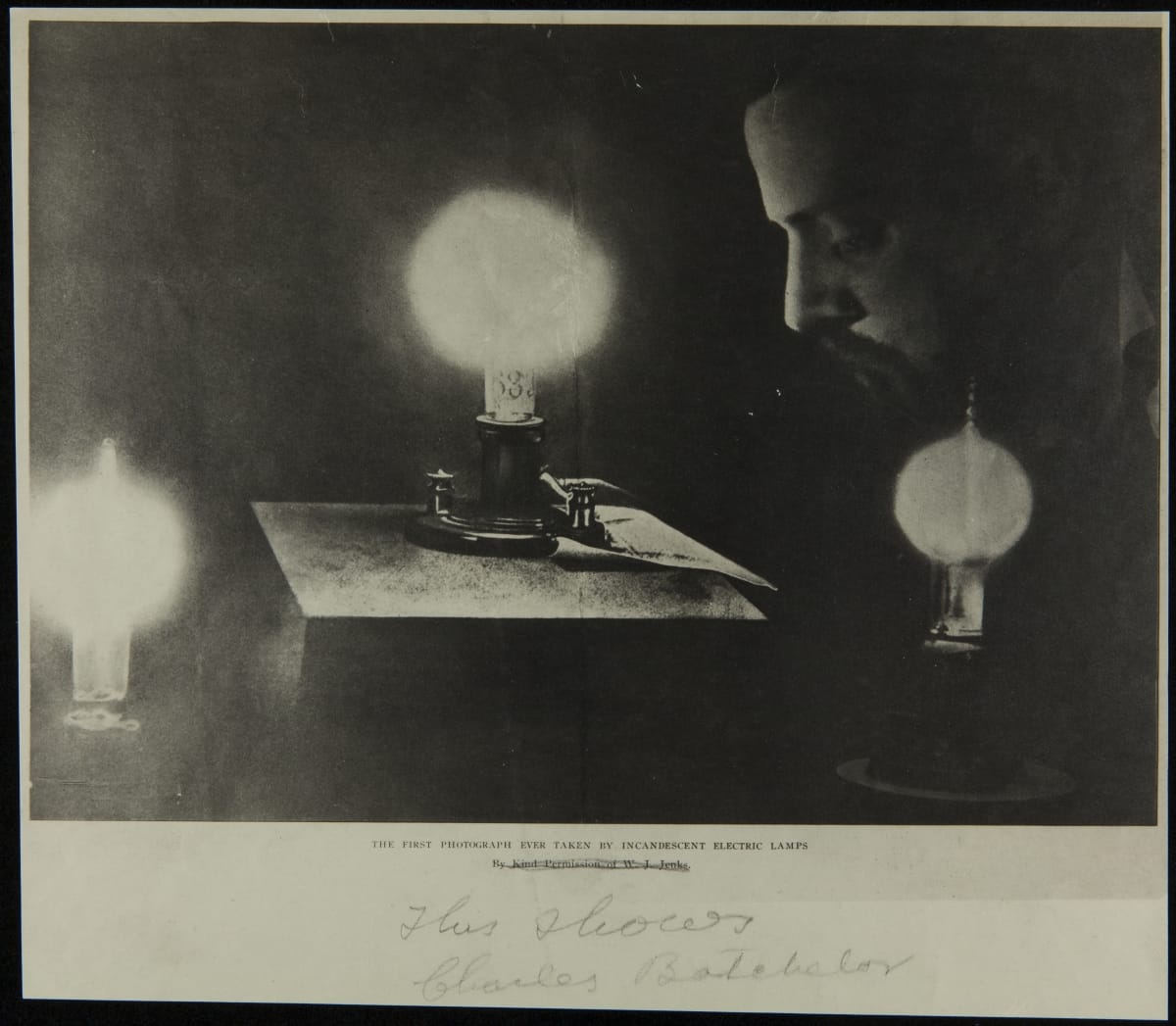 Portrait of Charles Batchelor, "First Photograph Made with Incandescent Light," 1880 / THF253728 |
| “As a practitioner of the craft of photography, I frequently employ the use of artificial light when making my photographs, the distinction being that the light emanates from a manmade source and not from the sun. |
Inside, Winters stands beside a bay of humming computer monitors with a Topo Chico. The cold bottle of sparkling water is perfect for slaking thirst and, as tradition holds, providing the next building block in a backyard pile of empties he’s dubbed Mount Topo. Through hundreds of annual deposits, the glass mountain now hosts a rotating colony of pill bugs, snakes, silverfish, and eleodes (beetles). It’s another world within worlds on the studio grounds, where nature and Winters’ collection of artifacts from nearly two centuries of photographic history meet the realities of an increasingly digitized future.
The encroachment of the elements proved calamitous in 2020, when winds clocking 75 mph tore at the metal roof and rainfall destroyed thousands of negatives in storage lockers below. While taking solace that well over a million negatives were safe, including those amassed from anonymous collections he’d found at junk stores and paper-goods shows, the incident nonetheless prompted the decampment for his Austin backyard, where proximity alleviates the increasing sense of vulnerability.
With another Topo tossed to the beetles out back, Winters begins detailing the international origins of the books on the shelves lining the original exterior wall of the post office. It called to mind the 1931 essay “Unpacking My Library,” in which German theorist Walter Benjamin wrote, “I have made my most memorable purchases on trips, as a transient.… How many cities have revealed themselves to me in the marches I undertook in the pursuit of books!”
Winters settles on Photography Album 1, edited by Pierre de Fenoyl, purchased at 23 while biking across Australia. “There’s amazing work in it, work that made me feel like photography was boundless,” Winters said. “I was riding from Sydney to Adelaide, and I had two panniers on my bike for storage. I rode that book for 1,300 miles, in a brown paper bag. I still have the bike; it’s at the house.” A casual flip through the book revealed a preserved leaf tucked inside. “We want to have a memory,” Winters added. “Certain objects will anchor us to a place and time.”
Dan Winters considers his desk, an old drafting table, the anchor of his studio. Littered with objects collected over time, he said of this space, “Sitting at the desk provides a connection to my history.” / Photo by Dan Winters
The undisputed anchor of the studio is Winters’ work desk, an old drafting table festooned with his full range of interests. “Sitting at the desk provides a connection to my history,” he said. “I’m inspired by the intrinsic value of these objects. Some have historical significance, certainly, and some are significant to me and my own path in life. Oftentimes they’re just beautiful objects I like to contemplate. One of the drawbacks of the collection is I feel it would be pretty quickly marginalized by whoever was settling my estate. At first glance, it probably looks like junk.”
According to theorist Benjamin, “the most distinguished trait of a collection will always be its transmissibility.” Winters senses the necessity of cataloging these objects in the moment and imparting their meaning. There’s the National Supply badge that belonged to his grandfather, whose company made transmissions for Sherman tanks. Or a rivet from the Golden Gate Bridge, flecks of international orange paint still visible. (Ironworkers presented the rivet ceremoniously to Winters after a photo shoot.)
| Lost in Space | |
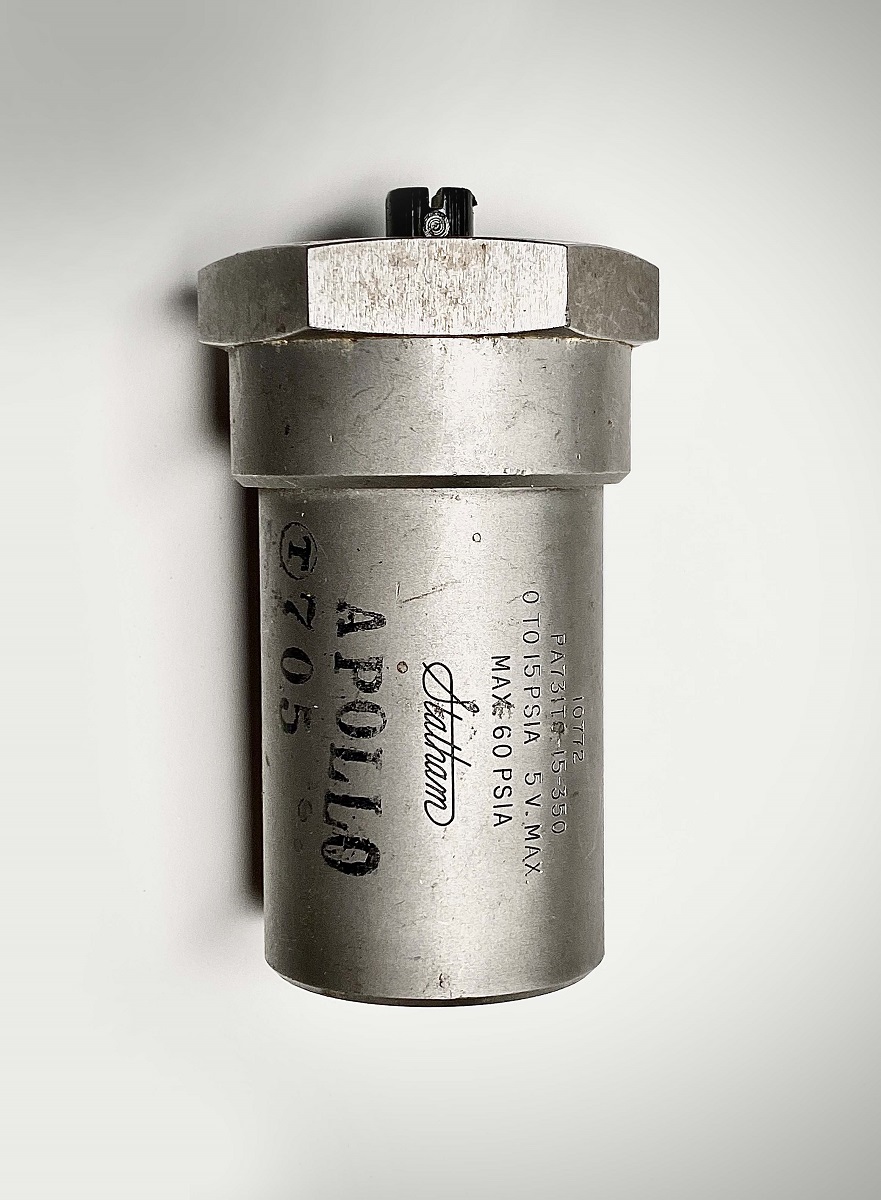 Photo by Dan Winters | 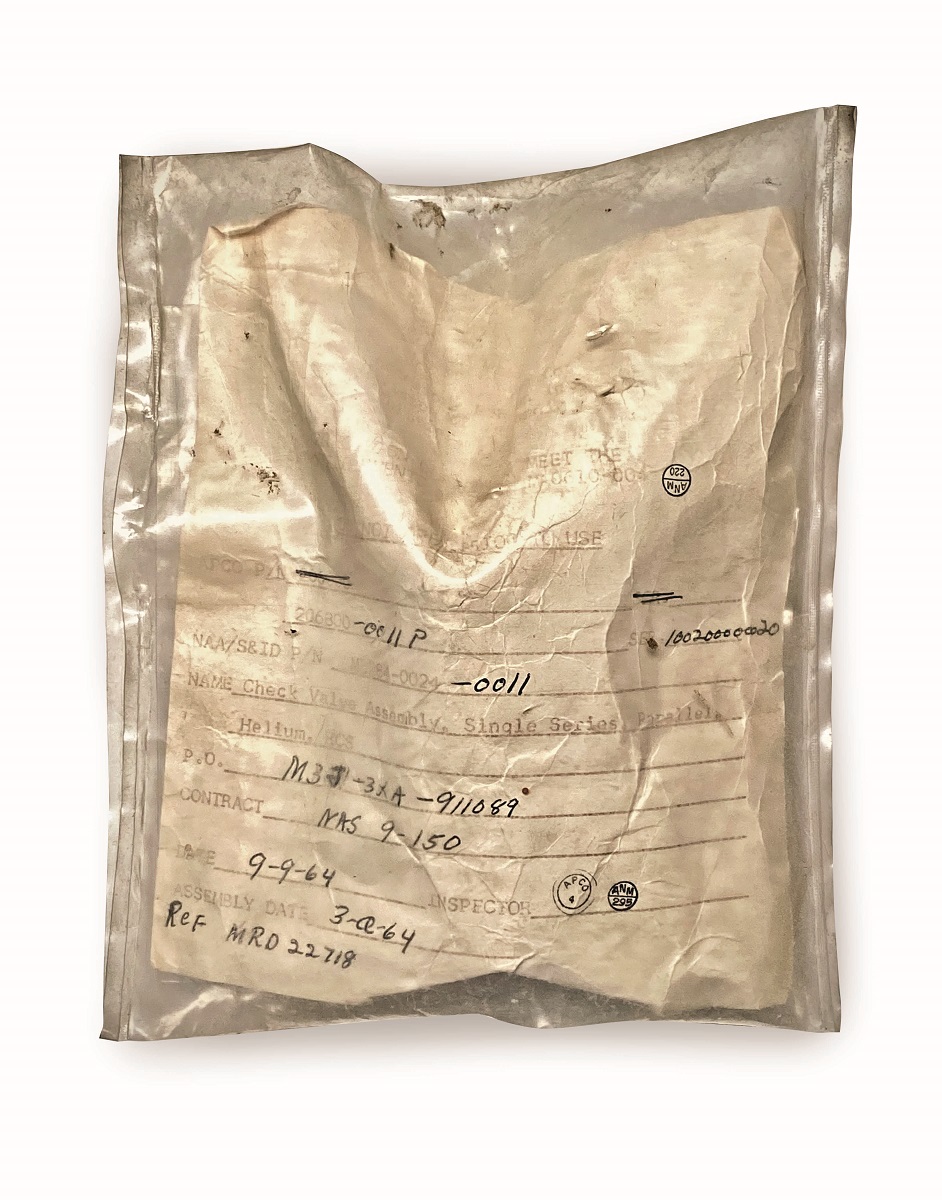 Photo by Dan Winters |
| Among Dan Winters’ desktop mementos are two pieces of equipment from the Apollo program: a pressure transducer (left above) and an RCS check valve assembly, still bagged (right above. Both were procured from a Los Angeles scrap dealer who capitalized on the closure of a Van Nuys plant operated by Rocketdyne, manufacturer of the Saturn V engines. The keepsakes have remained within reach ever since. | |
There’s also a swab attached to a wine cork, which is in fact a vital tool, one that facilitated a series of portraits for National Geographic that quickly became among Winters’ most widely seen images. Published in May 2021 and intended to draw attention to World Bee Day, the subject was actress Angelina Jolie covered in bees. Before the shoot, Winters and friend Konrad Bouffard contacted Ronald Fischer, an entomologist now in his 90s, who was “bearded” in bees for an iconic Richard Avedon portrait in Davis, California, in 1981. They also reached Avedon’s on-set beekeeper, who still had the cork swab he’d used to dot Fischer’s skin with queen-bee pheromone, thus attracting a swarm. As a lifelong beekeeper, Winters was honored to use the very same swab for his shoot and to be told he could keep the cork among his treasures.
It was hard not to draw a line to the cork-and-paper-clip spaceships Winters’ father left for him in the mornings, the ones that inspired him both to build and to collect. Asked if a cork ship was docked on his desk, Winter was convinced, though he couldn’t pinpoint one. “I know I have one in these boxes,” he said, sifting through cardboard stacks. He reminded himself to check later. For now, the day was still young, and the sun was out. In the shadow of Mount Topo, this message in a bottle would remain open, awaiting its cork.
James Hughes is a writer and editor based in Chicago. This post was adapted from an article in the January–May 2022 issue of The Henry Ford Magazine.
Texas, The Henry Ford Magazine, space, photography, photographs, movies, making, California, by James Hughes, books, 21st century, 20th century

The Henry Ford’s first edition of Julia Child’s consummate classic Mastering the Art of French Cooking, published in 1964. / THF621455
On the first Friday of every month, the collections experts of The Henry Ford share items from our archives and library collections on our Instagram account as part of our History Outside the Box virtual program. Though the Instagram stories are only available for 24 hours, we share them afterwards as videos so you can catch up on what you missed. For March, Librarian Sarah Andrus shared a sampling of the wide array of cookbooks, recipe booklets, and handwritten recipes that have found a home in our collections. Check out her selections below.
Continue Reading
History Outside the Box, by Ellice Engdahl, by Sarah Andrus, recipes, books, food