Posts Tagged by debra a. reid


Steam Engine Lubricator, 1882 / THF152419
You may have heard the saying, “The Real McCoy.” Popular belief often links the phrase to the high quality of a device patented by Black engineer Elijah McCoy.
Elijah McCoy was born on a farm in Canada to formerly enslaved parents. His father, George McCoy, had rolled cigars to earn the $1,000 required to buy his freedom. But money could not buy freedom for George’s love, Mildred “Millie” Goins, so George and Millie escaped her Kentucky master and became fugitives, settling in Colchester, Canada. They became farmers and had twelve children, including Elijah, born around 1844.
Elijah McCoy’s interest in machines led him to pursue formal study and an apprenticeship in engineering in Scotland. When he returned, he joined his family in Ypsilanti, Michigan.
Portrait of Elijah McCoy, circa 1895 / THF108432
But employers, blinded by racism, could not see his talent. Instead, in 1865, the Michigan Central Railroad offered McCoy the dangerous job of oilman and fireman. The need to constantly oil the moving parts of a locomotive AND shovel coal into the engine’s firebox soon sent him to the drawing board. In 1872, McCoy patented his own “improvement in lubricators for steam-engines,” the first of at least 52 patents and design registrations he secured during his lifetime.
For the next 40 years, McCoy patented many improvements for his automated oil-drip mechanism, updating his device as steam-engine design and operation changed. The steam engine lubricator cup pictured above (and on exhibit in Made in America in Henry Ford Museum of American Innovation) resulted from improvements patented in 1882. Today, the U.S. Patent and Trademark Office branch in Detroit bears his name, a fitting tribute to an innovator who moved locomotives—if not mountains.
This post was adapted from a stop on our forthcoming “Stories of Black Empowerment” tour of Henry Ford Museum of American Innovation in the THF Connect app, written by Debra A. Reid, Curator of Agriculture and the Environment at The Henry Ford. To learn more about or download the THF Connect app, click here.
Made in America, Henry Ford Museum, THF Connect app, railroads, Michigan, making, engineering, by Debra A. Reid, African American history

Microscope Used by George Washington Carver, circa 1900 / THF163072
This microscope, reputedly used by agricultural scientist George Washington Carver during his tenure at the Tuskegee Institute in Alabama, offers us a closer look at Black empowerment through Black education.
It took training to run educational laboratories, and administrators at Black schools sought qualified faculty to do the job. Booker T. Washington, principal at the private, historically Black Tuskegee Institute, recruited Carver as the one person who could build an agricultural research program comparable to the ones available to whites through other public land-grant institutions. Carver was qualified, having earned a master’s degree in agricultural science in 1896, the first Black American to do so.
Austin W. Curtis, Jr., who assisted Carver in his laboratory between 1935 and Carver’s death in 1943, donated and affirmed Carver's use of this microscope. Through it (and other scientific instruments), Carver documented the molecular structure of organic matter—the plants, fungi, bacteria, soils, and sedimentary material of Alabama and beyond. He translated his findings into how-to pamphlets, sharing strategies that Black families in the South could use to improve their own health and the health of their soils. Carver’s pamphlets also introduced hundreds of new uses for plant-based materials, ranging from livestock feed and medicines to pigments and synthetic polymers.
The highest level of learning requires analysis of original research. This microscope supported that cause while in use at Tuskegee Institute in Alabama, and it continues to help us focus on Black history.
You can see Carver's microscope for yourself in the Agriculture: Innovations in Farming exhibit in Henry Ford Museum of American Innovation.
This post was adapted from a stop on our forthcoming “Stories of Black Empowerment” tour of Henry Ford Museum of American Innovation in the THF Connect app, written by Debra A. Reid, Curator of Agriculture and the Environment at The Henry Ford. To learn more about or download the THF Connect app, click here.
Alabama, THF Connect app, Henry Ford Museum, George Washington Carver, education, by Debra A. Reid, agriculture, African American history, 20th century, 1900s

Detail, THF278671
An Introduction
Bees—one short name for about 20,000 species of flying insects classified into seven families. All live within social communities that depend on strict work routines; all seek the same food sources (pollen and nectar); and all process their harvest and preserve it in hives built in the ground, in hollow trees, or in human-designed apiaries.
Bees help plants reproduce by facilitating pollination as they search for pollen and nectar to feed themselves and their young. This relationship has long served plants well—DNA research confirms that bees coexisted with flowering plants from their beginning 130 million years ago.
Bees and humans have a much shorter, but more emotional, relationship. As pollinators, bees provide a critical link between humans and their food source: plants. Over millennia, humans domesticated one species of bee, native to Europe, Asia, and parts of Africa, to satisfy their needs—Apis mellifera, the Western or European honeybee. As Europeans colonized North America, they imported honeybees and the crops that honeybees pollinated from the bees’ native ecosystems.
Illustrations of Apis mellifera, the Western or European honeybee / THF621311
Humans clustered hives of honeybees around orchards, grape arbors, and other areas of intense flowering-plant cultivation to ensure pollination. From the hives, they harvested honey—a natural sweetener that required little processing. The hives also produced honey, pollen, and bee venom, which had medicinal value. Beeswax was used to seal containers, produce candles, and create art. And queens from the hives propagated even more honeybees.
Group of beehives (apiary) designed for pollinating a grape arbor / THF621283
The Honeybee Hunt
Historically, honey-seeking humans learned to identify the location of an existing hive, usually in a hollow tree trunk. Some “baited” bees by setting out a little honey to attract a bee and following it back to its hive. This involved “lining” a bee—watching until it flew out of sight, moving closer to that location, waiting to see another bee in flight, and repeating the process. In short increments, this led honey-seekers to hives.
To secure their “own” honey supply and facilitate pollination of crops, humans sometimes moved existing hives closer to their gardens, orchards, and clover fields. They also hunted bee swarms. When a colony becomes too large, a queen will “hive off,” leaving with a portion of the hive’s population. (In the meantime, the remaining bees create a new queen to lead the original hive.) The departing bees swarm together near their former home, lingering only temporarily as scout bees search for a new nesting site. The reward for aspiring beekeepers who successfully encourage a swarm to take up residence in a hive of their own choosing is sweet.
Aspiring beekeepers lured swarms or moved existing hives closer to their crops and kitchens. / THF621285
Housing Honeybees
Beekeepers first mimicked nature, luring swarms of bees into hollow logs much like the tree trunks they’d abandoned. Before long, humans devised prefabricated housing to keep pollinators close to gardens, orchards, and clover fields, and to keep honey close to the kitchen table. These hives, often grouped together in apiaries, took many forms, from simple boxes to highly decorated contrivances.


Manmade beehives ranged from hollow logs to simple boxes to complex, highly decorated inventions. / THF177143, THF172336, and THF172095
Some beekeepers made bee “skeps,” hives made of coiled rye straw held in place with a wooden splint, to house bees and protect honey stores. Skeps held real meaning for those who relied on them to house bees and protect honey stores. But bee skeps also took on symbolic meaning rooted in religious associations with worker bees and the biblical beekeeper, Deborah. Over time, skeps came to represent the industry of a productive household and the dependability of workers. Utah, known as “The Beehive State,” even adopted the coiled beehive as its official state symbol.
Some farm families made inexpensive skeps to house bees and protect honey stores. / THF177141
Medals awarded at the 1882 Cincinnati Industrial Exposition featured a bee skep (at bottom), symbolizing industry. / THF154061
During the mid-19th century, the U.S. Patent Office issued numerous patents for improved beehives. Arguably the most important went to Philadelphia pastor Lorenzo L. Langstroth in 1852 for his “Improved Mode of Constructing Beehives.” Langstroth's enduring contribution to beekeeping came through careful observation. He determined that bees naturally left a space of 3/8” between honeycombs (constructed within the hive to house larvae, honey, and pollen). Langstroth designed a beehive with 3/8” spacing (later coined the “bee space”) between the frames, sides, and bottom. This improved access, allowing beekeepers to remove and replace frames of honeycomb without harming bees, and more easily inspect for bee moth infestation, which could seriously damage a hive. The hive Langstroth devised, along with the guide he first published in 1853, revolutionized beekeeping, and Langstroth-style beehives remain standard today.
Lorenzo L. Langstroth’s careful observation of honeybees led to a revolutionary beehive design. / detail, THF621310
Careful spacing within Langstroth-style hives improved access for beekeepers and helped protect the bees. / THF172338
In Defense of Native Bees
Because they did not evolve in tandem with native plants, honeybees are not the best pollinators for all crops grown in North America. They seek nectar more than pollen to produce honey, and many plant blossoms do not produce enough nectar to mobilize honeybees. Native bees and other flying insects find blossoms of native plants—including tomatoes, cucumbers, pumpkins, avocadoes, and cranberries—more appealing than do honeybees, and they do a better job of moving pollen from blossom to blossom, ensuring fertilization. As a consequence, many market-garden and truck-farm crops (cabbage, carrots, squash, and melons), berries (strawberries, blackberries, and raspberries), and orchard crops (apples, pears, peaches, and plums) depend on native bees and other pollinators, even as honeybees play their role. All also pollinate crops that livestock eat (buckwheat and clover) and crops that produce fibers we use to make cloth (cotton and flax).
Native bees pollinate many food crops, including orchard fruits like pears. / THF293065
Vegetables, fruits, and other agricultural products result from the intimate relationships, millions of years in the making, between bees and the plants they pollinate. When colonists imported honeybees to North America, they introduced direct competition to different genera and species like squash bees, bumblebees, and solitary bees. Even today, humans’ special treatment of honeybees puts native bees at a disadvantage. As the disrupters of natural relationships, humans bear responsibility for creating a balance between honeybees and native species that are too often neglected in popular conversations. While we depend on honeybees for our honey supply, we depend on all pollinators to sustain our food system. To learn more, explore the U.S. Geological Survey’s documentation of native bees at the Native Bee Inventory and Monitoring Lab, check out this excerpt from Dave Goulson’s “A Sting in the Tale: My Adventures with Bumblebees,” or browse beekeeping-related artifacts in The Henry Ford’s Digital Collections.
This post was adapted by Saige Jedele, Associate Curator, Digital Content, from several write-ups on bees and beekeeping by Debra A. Reid, Curator of Agriculture and the Environment at The Henry Ford.
farming equipment, nature, by Saige Jedele, by Debra A. Reid, agriculture

Hiram Sibley & Co. Seed Box, Used in the C.W. Barnes Store, 1882-1888 / THF181542
Several million guests have seen a reproduction Sibley seed box, based on an original box in our collections, in the J.R. Jones General Store in Greenfield Village since 1994, when the box became part of the reinterpreted interior. Commercial seed sales of pre-packaged vegetable and flower seeds began in earnest during the 1860s, and by the mid-1880s, Hiram Sibley & Company advertised itself as the world’s largest seed company. That might be true. Sibley, who made his fortune as executive of the Western Union Telegraph Company, invested in farms and packing houses in several states and engaged in seed trade in several foreign countries. His entrepreneurial bent warranted more exploration, as did the details of the seed packets, all stowed carefully in the box in the General Store.
The reference photograph in our collections database for the original seed box showed a box with seed packets. The accession number, 29.1987.18.1, indicated that this was an early addition to The Henry Ford’s collections—the first number, 29, means that it was acquired in 1929. The second number indicates that it was in the 1,987th lot acquired that year, and the third number indicates that the box was the 18th item in the 29.1987 grouping. In fact, as research ultimately disclosed, our collections included the box, plus 108 original seed packets and a Sibley & Co. Seed catalog.
My need to know more started a chain reaction. First, this object had been in the collection for 90 years. It has known provenance: Accession records indicate that it was purchased with other items from a store in the tiny, rural, upstate New York community of Rock Stream. The Barnes family—Charles W. and then his son, Alonzo S.—operated the store. Alonzo died in 1929, which may have precipitated the sale. Our registrars researched and catalogued all parts of the set. We also acquired archival documents—a map of the town from the time the Barnes family operated the store and two postcards of the town—for our collections to add context around the seed box.
Main Street, Rock Stream, New York, 1908-1910 / THF146163
Filling in details about seed packets required further reconnaissance. This required removing the seed box from exhibit at the end of the 2019 Greenfield Village season. Our Exhibits team moved the reproduction box and the authentic seed packets it contained to our conservation labs. Conservation staff removed the packets, checked for damage, then cleaned and prepared the packets for digitization. In the meantime, Collections Management staff located the original box in collections storage and moved it to the conservation labs for cleaning.
Once the packets were cleaned, they were moved to our archives, where the packets were imaged. After the box was cleaned, Collections Management staff moved it to the photography studio. The individual seed packets, once imaged, also were moved to the photo studio. There, the packets rejoined the box, fitting into compartments spaced to accommodate “papers” as well as multiple-ounce “packets” of seeds. The final photograph above shows the rejoined box and original seeds – cabbage, carrot, cauliflower, eggplant, onion, pea, rutabaga, tomato, turnip, and other vegetables.
Some of the individual seed packets that were digitized. See them all in our Digital Collections.
After the photo session, the seeds returned to the reproduction box, the box was sealed with its Plexiglas top to protect them, and Exhibits staff returned the box with its contents to the General Store in Greenfield Village.
It is important to note that the investigation, relocation, cleaning, digitizing, photography, and cataloging all occurred between January and March 2020, before COVID-19 closed the museum and delayed the opening of Greenfield Village. During that closure, between March 15 and July 9, the digitized records became part of numerous blogs written to meet the needs of patrons seeking information about food sources, vegetable gardening, food security—and about tomatoes!
It may seem difficult to justify the amount of time required from so many people to digitize one box and its many seed packets during the process. Each staff member involved in the process had to juggle numerous competing projects to make time to attend to the box and its packets. However, their work created invaluable digital resources that have already enhanced several of our blog posts. We may never know how many people were inspired to plant their own vegetable garden during a year of uncertainty partially, or wholly, because of “How Does Your Vegetable Garden Grow?,” or who just had to have a BLT after reading “Multiple Takes on Tomatoes.”
This is what digitization can do, and this is the effort that it takes. We all do it in the spirit of life-long learning.
Continue Reading
1880s, 19th century, Michigan, Dearborn, New York, research, photography, Greenfield Village buildings, digitization, digital collections, COVID 19 impact, collections care, by Debra A. Reid, #digitization100K, #Behind The Scenes @ The Henry Ford
A perfectly ripe tomato is a classic summer joy. But did you know that the growing of tomatoes has ties to many aspects of our history and culture? Curator of Agriculture and the Environment Debra Reid uses our collections to reveal the many facets of the tomato.
The tomato -- a little fruit -- has big lessons to teach.

Tomatoes Growing in a Home Garden, circa 1915 / THF252180
First, yes, that’s right. Tomatoes are, biologically, a fruit – a berry that matures on a flowering plant. As this circa 1915 stereograph explains, “at first they were only small green things that grew where the blossoms dropped off.” Yet, the small green fruit grew into a plump, juicy “culinary vegetable,” considered such because of its low sugar content. (For example, processors transformed the fruit into a spicy vegetable sauce – catsup! – the savory contrast to sweet fruit sauces like apple butter.)
The image above shows a boy named Bob and his two sisters amidst the tomato plants they raised from seed, proudly displaying plants loaded with fruit. The Keystone View Company included an educational message on the back of the stereograph to engage children with growing fruits and vegetables. Bob and his sisters planned to share their finest tomatoes with others during their school garden show. They became role models for other students sprouting seeds and planting seedlings and then weeding and watering their crops.
By growing tomatoes, these children learned about domestication, the process by which humans select seed from bigger or tastier fruits or from plants that survive a disease or a drought. They cultivate these seeds (planting, weeding, harvesting, saving seed, and replanting year after year). This results in cultivars, each with different shapes, textures, colors, flavors. Over generations, humans have created more than 10,000 tomato cultivates by saving seed from their best tomatoes.
Why do tomatoes come in so many different shapes, sizes and colors?
Tomatoes in the background and white eggplant in the foreground of the wheelbarrow. Photograph by Debra Reid, taken Saturday, August 15, 2020, at the kitchen garden at Firestone Farm.
Evolution resulted in distinctive varieties, but humans have also picked good-tasting fruits to propagate. (See how many different cultivars this proud gardener grew in the mid-1940s!)
The historic gardens in Greenfield Village include heritage cultivars documented in historic sources and saved through traditional seed saving. Three tomatoes often grown at Firestone Farm (pictured above) include Red Brandywine, Oxheart and Yellow Pear.
As demand for quality seeds grew during the second half of the 19th century, commercial seed businesses flourished. Companies such as Hiram Sibley & Co. contracted with growers to produce seed in clearly marked packages for customers to purchase. In addition to illustrations of the cultivar, the packet included descriptions of the qualities of the fruit, as well as best practices of cultivation (often in more than one language).
Hiram Sibley & Co. tomato seed packet, “Early Acme” cultivar, 1880s. THF278980/THF278981
Noted plant breeder Luther Burbank (1849–1926) crossed varieties to create hybrid cultivars that did not exist in nature. He sought disease resistance as well as a meaty tomato that had more pulp than seed – the meatier the tomato, the heartier the sauce! Some of Burbank’s varieties are still sold today.
Charles C. Hart Seed Company "Burbank Slicing Tomato" seed packet, circa 2018 THF276144/THF276145
Twentieth-century concerns about food quality and nutrition led to the popularity of seeds like “Double Rich,” which were certified organic and yielded tomatoes with twice the Vitamin C!
You can learn more about organic cultivation and its relationship to the plant breeding process from the U.S Department of Agriculture’s (USDA) Organic Integrity Database, and about biotechnology, including hybridization, from this USDA glossary.
Have you ever wondered who grows the tomatoes sold in cans or bottles?
Product label for tomato catsup by Heinz, Noble & Co., 1872-1873 THF117246
Anyone with yard space enough can grow tomatoes. Yet, by the time home gardeners like Bob and his sisters planted their crop in the early 20th century, many urban Americans wondered what a vine-ripened tomato tasted like. Why? Because tomatoes could be easily processed into affordable packaged products, and most urban consumers paid clerks in general stores to pick tomatoes off the canned goods shelf.
Workers harvest tomatoes at a Heinz tomato farm near Salem, New Jersey, 1908 / THF252058
Companies like the H. J. Heinz Company contracted with farmers to meet the demand for canned goods and catsup. Their production far exceeded the yields of home gardens. Heinz ensured success by growing seed tomatoes from which the best seeds became the basis for the next year’s crop. The company maintained a network of greenhouses to start the plants that growers put in the ground.
A rapid, careful and organized tomato harvest and transport led to high-quality processed foods. A sense of urgency dictated the harvest season, which began with careful picking and packing of the delicate and perishable fruit in special crates and baskets. It continued as laborers moved the full containers from fields to shipping points. Specially designed wagons and baskets reduced stress on the ripe fruit during transit. Only the best tomatoes made the journey to H.J. Heinz plants. Laborers discarded damaged fruit into barrels and packed others into baskets for shipment.
Shipping tomatoes by boat, H. J. Heinz Company, Salem, New Jersey, circa 1910 THF292108
Transporting tomatoes from truck farms to Heinz processing plants sometimes involved sailing vessels loaded with ripe fruit. At the height of harvest, barges carried loads of tomatoes from farms to processors. Growers in Salem, New Jersey, used the Salem River, a tributary to the Delaware River, to send crops to processing centers near large east coast markets, including Philadelphia and New York.
Mass production of tomatoes did not make home gardening obsolete.
Man inspecting tomato plant in Victory Garden, June 1944 / THF273191
In fact, times of economic hardship increased the general public’s interest in growing their own tomatoes. During the Great Depression, Henry Ford dedicated 1,500 acres of Ford Farms land (between Birmingham and Flat Rock, Michigan) to vegetable gardens. Ford Motor Company employees could sign up to tend a garden plot and retain the produce. Interest in growing tomatoes remained high during World War II, largely through the U.S. government’s Victory Garden program.
Home-grown tomatoes could even be symbols of resistance. George W. Carver encouraged farm families to grow tomatoes for the table as a strategy to strengthen their position, economically and socially.
Tomatoes have legal, ethical, and policy implications.
United Farm Workers Flag, circa 1970 / THF94392
Tomatoes have been at the heart of economic conflict between growers and laborers. California growers produced 85 percent of tomatoes canned in the United States by 1940. The larger the fields, the more urgent the need for laborers to harvest a crop that quickly moves from maturity to rot.
Most large-scale growers relied on migrant agricultural laborers at harvest time. They worked for wages determined by the grower and did not receive protection under legislation passed during the New Deal that established minimum wage, maximum hours and workers’ compensation. Instead, growers had legal protection to hire agricultural laborers for wages below the legal minimum and were exempt from compliance with maximum hour and overtime regulations. This meant that laborers had to work until the perishable crop was completely harvested.
Edward R. Murrow’s 1960 news report, Harvest of Shame, increased attention to the plight of U.S. agricultural laborers along the East Coast. Then, in 1965, Filipino-American laborers, members of the Agricultural Workers Organizing Committee, launched a strike to protest pay and working conditions. Latino pickers, members of the United Farm Workers Association, joined with them, and began a five-year strike in and around the grape fields of Delano, California. Consumers increasingly sympathized with the laborers on whom growers of other perishable crops depended.
FMC Tomato Harvester, 1969 THF151662
Mechanical tomato harvesters became commercially viable in the context of this successful strike. When the FMC Corporation introduced its Cascade Tomato Harvester, Model 69W, in 1969, it advertised the machine as the savior of a multi-million-dollar crop and the preserver of the American people’s eating habits. The machine did not eliminate humans from the picking process, but it sped it up. FMC explained that it “picks a crop at the rate of nine tons per hour and cuts the cost of handpicking by 40 to 50 per cent.” Crews who operated the machine included a driver, a mechanic, and ten to twelve individuals who rode on the machine and removed debris from the picked tomatoes. This machine carried crews through midwestern fields, last on a farm near Grant Park, Illinois, between 1983 and 1990, which produced for the Heinz catsup factory in Muscatine, Iowa.
Changing harvesting practices required changing the form of tomatoes, too. Mechanical engineers believed the shape of San Marzano tomatoes would suit harvester belts. Plant breeders spent 30 years cross-pollinating tomatoes (including the San Marzano) to create a new hybrid that tolerated mechanical harvesting. In addition to uniform size and firmness, the fruits had to all mature at the same time on one plant, and they had to come off the vine easily.
Could scientists really slow the aging process? Microbiologists at Calgene, Inc. began research with that goal in mind in 1981. Their work paid off by 1988 with the “first commercially available genetically engineered whole food,” the Flavr Savr™ tomato. Genetic modification had shut down a protein that ripened fruit. It resulted in a tomato that could “last up to four weeks in a non-refrigerated state” (Martineau, pg. 4). An assessment of safety of the genetically modified tomato published in 1992 determined that the Flavr Savr™ remained a tomato and was food. (It bears mentioning that genetically modified tomatoes tend not to be listed in the Cultivated Plant Code because they derive from lines still being developed.)
Page from Safety Assessment of Genetically Engineered Fruits and Vegetables: A Case Study of the Flavr Savr™ Tomato from The Henry Ford's library.
Hungry for more on this little fruit with big impact?
The Acme tomato in the Firestone Farm garden, August 21, 2018. Photograph by Debra A. Reid.
The Henry Ford has resources to help you explore the complete tomato trajectory to date.
You can….
- See tomatoes growing in three gardens in Greenfield Village (Firestone Farm, Ford Home, and Mattox Farmhouse). And, learn why there are no tomato plants in the Daggett house garden!
- Visit Luther Burbank’s Bureau of Information in Greenfield Village, originally located at the corner of his experimental gardens in Santa Rosa, California.
- Take a closer look at the FMC Cascade Model 69W tomato harvester on exhibit in Henry Ford Museum of American Innovation.
- Explore digitized archival materials from collections housed in the Benson Ford Research Center.
- Put together your own virtual exhibit of THF tomato resources, from fruit on the vine with that just-picked taste, to artistic whimsy and mouth-watering graphic design, explore the possibilities.
Sources
- Charles, Daniel. Lords of the Harvest: Biotech, Big Money, and the Future of Food. Perseus Publishing, 2001.
- Dreyer, Peter. A Gardener Touched with Genius: The Life of Luther Burbank. Rev. Ed. University of California Press, 1985.
- Hersey, Mark D. My Work is That of Conservation: An Environmental Biography of George Washington Carver. The University of Georgia Press, 2011.
- Martineau, Belinda. First Fruit: The Creation of the Flavr Savr™ Tomato and the Birth of Biotech Food. McGraw Hill, 2001.
- Redenbaugh, Keith and William Hiatt, Belinda Martineau, Matthew Kramer, Ray Sheehy, Rick Sanders, Cathy Houck, and Donald Emlay. Safety Assessment of Genetically Engineered Fruits and Vegetables: A Case Study of the Flavr Savr™ Tomato. CRC Press, 1992.
Debra A. Reid is Curator of Agriculture and the Environment at The Henry Ford.
farming equipment, food, by Debra A. Reid, agriculture, #THFCuratorChat

Keystone Stereograph #149 “Harvesting Celery Blanched by Boards, in Michigan’s Famous Celery Fields, Kalamazoo, Mich. THF 145691
What comes to mind when you think of celery (Apium graveolens L. var. dulce)? The essential ingredient in chicken soup, an attractive tomato drink garnish, a low-calorie and healthy snack (with peanut butter added!), or all of the above? The low-calorie nutritious vegetable (in the same family – Apiaceae -- as the herb, parsley) can also lead you on a journey through local history, consumer demand, patent medicine promotion, and commodity chains that spanned the globe.
The ancient Greeks and Romans harvested seeds from wild celery, also called smallage (Apium graveolens L. var. secalinum). It grew best in temperate climates and in moist soils. The plant stalk and leaves had curative properties and seeds had a strong flavor and scent when dried and when processed into essential oil. Europeans included celery seed into tincture recipes in pharmacopeia and cultivated the crop in gardens by the mid-1600s. Over centuries plant-breeders created celery varieties with taller tastier stalks. Thus, celery shifted from a landrace (a plant evolving in a location over time) to a market garden crop by the mid-19th century. Celery growers in the Grand Rapids area helped make it an international commodity.
Kalamazoo Celery Company, How to Grow Celery, 1886
The Celery Fields near Grand Rapids, Michigan
Agricultural stories start with land access (or lack thereof).
The introduction and expansion of celery cultivation in west central Michigan began in the decades following removal and confinement of indigenous people. Maps indicate the rapid changes that occurred as lands once tended by the Match-E-Be-Nash-She-Wish Band of Potawatomi became the property of Euro-Americans.
John Farmer published this map in 1831 and marketed it as “The Emigrant’s Guide; or, Pocket Gazetteer of the Surveyed Part of Michigan.” It included “An improved map of the surveyed part of the Territory of Michigan.” THF136462
The wetlands that once sustained indigenous agriculture became a commodity that other entrepreneurs used to build a celery empire. The map that J. H. Young produced in 1835, “The Tourist’s Pocket Map of Michigan,” implies a leisurely pursuit, but instead, developing land into productive farms consumed time and money, and it required brute force. Yet, settlement equated to “progress” and economic growth in the expanding nation and in the territory of Michigan.
J. H. Young, “The Tourist’s Pocket Map of Michigan,” 1835. THF136466
Celery Entrepreneurs
Different individuals, all migrants to the area, receive credit for launching the celery enterprise. George Taylor, a Scottish market gardener, reputedly introduced commercial celery growing in the United States when he settled in Kalamazoo in 1855.
Other individuals, all well-heeled citizens of the area received credit as celery pioneers. Joseph Dunkley, an immigrant from Somersetshire, England, established celery fields by 1866 north of Kalamazoo and began shipping his crop via rail in 1880 to eastern and southern markets. Glenn Douglass Stuart received most acclaim -- “Were the lovers of this esculent herb to have a voice he would be crowned what he is already, ‘The Celery King’.” Stuart arrived from Gowanda, New York, via Oberlin, Ohio, in 1883, and by 1892 his biography in the 1892 Portrait and Biographical Record claimed that his firm (based in celery) employed one-quarter of the Kalamazoo population.
Joseph Dunkley’s nursery business, Kalamazoo, Michigan, “Portrait and Biographical Record of Kalamazoo, Allegan andOttawa Counties” (1892), pg. 935.
Lands further west developed as celery fields later. Celery pioneer George Hudson introduced the crop to Grand Haven around 1878, according to the 1892 history of Ottawa, County, Michigan. Hudson immigrated from Devonshire, England, worked as a market gardener in New York, and a lumberman in Spring Lake before settling down to celery in the Grand Rapids area.
Advertisement of George Hudson, “Historical and Business Compendium of Ottawa County, Michigan” (1892), pg. 30; with information on Mr. Hudson (pgs. 192-193).
Immense fields of celery thrived by 1880, and dominated in celery production to the 1940s, earning two cities on both ends of the celery zone the names “Celery City” (Kalamazoo) and “Celery Center” (Hudsonville).
Laborers in the Fields
While some immigrants received accolades for establishing the industry, other individuals received little recognition for the labor they performed. Families who migrated from The Netherlands did the bulk of the work turning wet soils into fertile celery fields between Kalamazoo and Hudsonville. Stereographs and postcards depict the intense physical labor that farm owners and laborers performed.
Keystone Stereograph #149 “Harvesting Celery Blanched by Boards, in Michigan’s Famous Celery Fields, Kalamazoo, Mich. THF145692
Growing Celery
Before celery growing became concentrated in the area near Grand Rapids, market gardeners raised the spring vegetable and sold it directly to customers in public markets. The May 15, 1849 issue of The Michigan Farmer included growing directions from an English gardener. He advised planting the seeds in January in a greenhouse (and following with additional plantings in February and March to stagger harvests and meet market demand). Then growers should transplant the seedlings to the garden and protect the plant with a “hand glass.” Growers then earthed up the celery, setting the plants in trenches and hilling the soil around them to shield stalks and leaves from the sun. This reduced the acidic taste and stringiness of the stalks.
Such intensive cultivation practices yielded a crop that met the demand of wealthier customers seeking a spring tonic. A speaker explained the advantages of celery to members of the Kalamazoo Agricultural Society in 1850 -- celery was “peculiarly acceptable because it comes when our horticulture has no other fresh supplies to offer us.” The only other vegetables available at the time included potatoes, turnips, and cabbage. Such intensive
After Harvest
Wealthier families displayed the fresh leafy celery stalks in glass vases like this one. The vase held chilled water that helped keep celery stalks fresh during formal dinners. Diners consumed the carefully cultivated stalks raw.
Celery Vase, 1820-1840. THF 168522
The cost of celery declined as mass production and marketing reduced the cost per bunch. This shifted celery from a delicacy to an essential vegetable for a growing non-gardening population.
Celery after harvest, took other forms.
Product Label for Celebrated Celery Sauce by Heinz & Noble, "Put Up Expressly for Family Use," 1871. THF117109
Product marketing often featured larger-than-life products derived from celery.
Heinz wagon with Celery Sauce advertising, circa 1879. THF 117121
Celery, the vegetable grown around Grand Rapids, attracted the attention of health food entrepreneurs like Dr. Vincent C. Price (1832-1914). He purchased Tryabita Celery Food Company in Battle Creek, Michigan, in 1902 and operated it as Price Cereal Food Company. He also produced and marketed Dr. Price’s Wheat Flake Celery Food as essential for the health of vegetarians and the infirm.
Advertising Poster, "Dr. Price's Food, Nature's Food for Man, the Only Wheat Flake Celery Food," circa 1910. THF 96676
Celery growers in the Grand Rapids area helped establish the crop in Sanford, Florida, in 1895. Growers planted in the fall and harvested in the spring. By 1898 they started shipping their crop via refrigerated railcars to northern markets including Philadelphia and New York City. California growers also established celery fields from Kalamazoo stock by the late 1890s, but their harvest reached market during the fall, thus theoretically avoiding direct competition with other growing areas.
Celery did not appear on lists of common garden vegetables because creating a tasty crop required more work than most hobby gardeners wanted to commit to the crop. Thus, celery did not usually appear in photographs or graphic arts that depicted garden baskets laden with potatoes, beets, cabbage, turnips, and other vegetables. This poster from World War I proves an exception, featuring a schoolboy with a healthy bunch of celery in his basket (on the left side, between the onions and the beets).
World War I Poster, "Raised 'Em Myself in my U.S. School Garden," circa 1918. THF112810
As salads became a more common element of American dinners, fresh celery gained more visibility. This advertisement for Heinz vinegar (an essential salad-dressing ingredient) included a bunch of celery, along with another relatively new addition to American dinners, iceberg lettuce (behind the celery and the vinegar bottle).
Advertising Layout Drawing for Heinz Vinegar, 1924. THF292743
Celery reached consumers in packing crates. Storekeepers usually displayed the crop in the crate, as this image of J. F. Ryder’s Market in Maine, shows.
Grower cooperatives helped expand markets during the early 20th century. The Celery Growers of Michigan existed at least by 1935, the year that growers specified six standard packages for celery. This container was a "square" at the ends (8 inches by 8 inches) and it held celery bunches laid flat that were 10 inches to 18 inches in length.
This “square” packing crate likely came full of celery from the farm operated by Ralph Schut, a descendant of Dutch immigrants in Georgetown Township/Hudsonville, aka “Celery Center.”THF173353
Historically, celery was much more than a garnish in your favorite tomato-juice drink.
Heinz Tomato Juice Advertisement, “Talk About Your Aristocracy!,” circa 1935. THF252238
Why are there more tulips in Holland and the Grand Rapids area today than celery? Growers responded to disease affecting their crops and increased competition reducing their market dominant by concentrating their resources on horticulture. Many celery growers already had green houses and operated nurseries, so they diversified their production by adding bedding plants and flowers to their market crops.
The region’s celery history remains visible through the Celery Flats Interpretive Center in Portage and in celery fields managed by grower-members of the Michigan Celery Cooperative, founded in 1951.
Debra A. Reid is Curator of Agriculture and the Environment at The Henry Ford.
20th century, 19th century, Michigan, food, by Debra A. Reid, agriculture
What measures do you use to judge whether food is “healthy”? What connections do you see between healthy food and healthy communities? Today the concept of “food security” links nutritious food to individual and community health. This blog features historical resources in the collections of The Henry Ford that help us explore the meaning of “food security.” Many relate to the work of Black agricultural scientist George Washington Carver with Black farm families in and around Tuskegee, Alabama, between the 1890s and 1940s.
What Does "Food Security" Mean to You?
A big meal often symbolizes food security. You can almost smell the roast goose (once preferred to turkey) and taste the fresh apples, oranges and bananas in this centerpiece on a family’s holiday table!
Family Seated at Dining Table for a Holiday Meal, circa 1945. THF98738
But does having a big meal on special occasions mean that a person, a family, or a community is “food secure”?
The Food and Agriculture Organization of the United Nations (FAO) explains that a person is “food secure” if they have regular access to safe and nutritious food in amounts required for normal growth and development and in quantity and calories needed to maintain an active and healthy life.
Students at this South Carolina school all appear healthy. This implies that they have access to a quantity of nutritious food necessary for normal growth. It also implies that they consume it consistently which helped keep them healthy and better able to complete their schoolwork.
School Teacher and Her Students, Pinehurst Tea Plantation, Summerville, South Carolina, circa 1903. THF115900
Historically, many farm families raised much of the food they needed to survive, including meat, vegetables, grains, and fruit. The Mattox family farmed their own land, and they dedicated time and energy to tending their garden and raising their own beans and sweet corn (as pictured in this photograph). Being responsible for your own food supply required careful planning and hard work year-round because families had to grow, process, preserve, and then prepare and consume what they (and their livestock) ate. As long as everything went according to plan, and no disasters arose, a family might be food secure.
Mattox Family Home in Greenfield Village, 1991. THF45319
Many factors led to food insecurity. This indenture for three orphaned children, William (7 yrs old), Dennis (5 yrs old) and Henry (18 months old), specified that they receive “a sufficiency of food.” What did “sufficiency” mean? Consuming calories might provide energy to work, but calories alone did not (and do not) ensure a healthy life. Furthermore, being unfree made these indentured children dependent on someone else who might have other ideas about what “sufficiency of food” meant.
Indenture for "...Colored Children Named William, Dennis & Henry," July 20, 1866. THF8563
Cotton and Food Insecurity
Southern farm families often grew cotton as their cash crop. Farm families could not eat cotton though the seed yielded byproducts used in livestock feed, and oil that became a popular cooking ingredient. Landowners and tenant farmers could strategize how much cotton to grow, and could plant corn to feed their hogs, and could dedicate land for a garden. Yet, many families across the rural South, Black and white alike, farmed cotton, and they received a share of the crop they grew as payment for a year of labor. Owners expected these sharecroppers to focus their energy on the cash crop – cotton - and not spend valuable labor on raising their own food. Instead, families became even more economically insecure by buying inexpensive food on credit.
Picking Cotton, Louisiana, 1883-1900. THF278896
Many sharecroppers and agricultural laborers in the South lived on a diet of meat (pork), meal (cornmeal) and molasses (processed from either sugar cane or sorghum) – the 3M diet. While pork in its many forms (including lard sandwiches) and cornbread with molasses provided much needed calories, the 3M diet did not deliver nutrients needed to maintain health. Niacin deficiencies led to the debilitating disease, pellagra, which afflicted impoverished people across the South and beyond.
Trade Card for Silver Leaf Lard, Swift & Company, 1870-1900. THF225588
Inadequate supplies of food, and diets lacking in nutrients, undermined food security. Racism also undermined access to adequate foods. Graphic arts advertising southern staples often reinforced racist stereotypes rather than reality – that Black women often held positions of authority as Black cooks who prepared meals for others who could afford fresh foods and a varied and nutritious diet.
Advertising Poster, "Old Fashion Molasses," circa 1900. THF8044
Improving rural health required a revolution that reduced the dependency on cotton and increased the types of crops grown for market. George Washington Carver, the first Black American to hold an advanced degree in agricultural science, used his knowledge to try to convince farmers to improve soils to increase cotton yields, but to also raise additional crops such as sweet potatoes and peanuts.
George Washington Carver's Graduation Photo from Iowa State University, 1893. THF214111
George Washington Carver’s Work with Peanuts
Many associate Carver with peanut butter, but his relationship to peanuts far exceeds peanut butter.
A man in Montreal, Canada, secured a U.S. Patent for peanut candy – a paste sweetened with sugar – in 1884. At that time George W. Carver had been living for five years in Kansas working as a cook and laborer. Between 1886 and 1888, after being refused entry into a college in Kansas, Carver homesteaded near Beeler, Kansas.
Alabama, the location of Tuskegee Institute, where Carver went to work in 1896, ranked fourth in peanut production in 1900 behind Virginia, North Carolina, and Georgia. Farmers in these states raised most of the raw product that Northern food processors like H.J. Heinz dry roasted and ground into peanut butter. This Heinz peanut-butter packaging features a blond blue-eyed girl in a grain field holding lilacs. This did not accurately represent southern farm families raising the high-quality crop that Heinz depended on for its “choicest peanuts.”
Trade Card for H.J. Heinz Company, “Mama’s Favorites,” circa 1905. THF215296
As consumer demand for peanut butter increased, production increased. Nutritionists understood the value of peanuts and of peanut butter as an inexpensive source of plant-based protein, fats, minerals and vitamins. Farm families could eat their own home-grown peanuts but could also find a ready market for them.
Women grinding peanuts into peanut butter at Heinz. THF292973
Tuskegee, Alabama was located just north of the peanut-growing region of southeastern Alabama. Carver set about to convince Black landowning farmers in and around Tuskegee to take advantage of the market opportunity. Orchestrating a more complete overhaul of cotton-dependent Alabama agriculture required convincing white landowners to free sharecroppers from requirements to grow only cotton. Others sought a revolution in civil rights through legal means. Even though many criticized the self-help message, families who ate better could channel new-found energy toward securing civil rights and social justice.
Carver appealed to his constituents in writing. He linked concerns about health and nutrition to economic independence in his May 1917 pamphlet, “How to Grow the Peanut.”
Bulletin, How to Grow the Peanut and 105 Ways of Preparing it for Human Consumption, 1917. THF213329
Carver described the peanut as having “limitless possibilities.” The “nuts possess a wider range of food values than other legumes.” THF213331
Carver described 105 ways to prepare the peanut – ground, boiled, roasted, and as a main ingredient in soups, salads, candy, and replacement for chicken, and other meats. THF213335
Crop Innovations
Carver applied his life-long fascination with plants to identify crops in addition to the peanut that had the potential to displace cotton. He used this weeder to collect specimens. He studied their molecular composition, extracted byproducts, and devised new uses for them.
Weeder Used by George Washington Carver at Greenfield Village, 1942; Gift of Henry and Clara Ford. THF152234.
Carver promoted crops through short publications that stressed financial and food security.
Some crops occurred naturally, the wild plum, for instance, which landowning farmers might have on their property but that they undervalued as a food source.
Bulletin, “43 Ways to Save the Wild Plum Crop,” 1917. THF288049
During World War I, Carver promoted crops that Alabama farmers grew, but that could be processed into alternatives to wheat flour. THF290275
During the 1920s, Carver urged farmers to grow even more crops that they could eat, such as sweet potatoes.
How the Farmer Can Save His Sweet Potatoes, 1925. THF37735
During the 1930s, as economic conditions worsened during the Great Depression, Carver published a pamphlet focused on growing the tomato, a vitamin- and mineral-rich food source.
Bulletin, “How to Grow the Tomato and 115 Ways to Prepare it for the Table,” 1936. THF288043
Carver, Food Byproducts, and Food Security
Carver’s research into plant byproducts and new foods from farm crops caught the attention of Henry Ford.
Carver and Clara and Henry Ford corresponded about topics as practical as gravy made from soy and peanut flour, and as personal as digestive systems.
Letter from George Washington Carver to Clara Ford, March 19, 1940. THF213553
Henry Ford recognized Carver’s inspiration by naming the Nutrition Laboratory in his honor on 21 July 1942.
George Washington Carver and Edsel Ford at the Carver Nutrition Laboratory, Dearborn, Michigan, 1942. THF213823
Peanut Oil: A Byproducts Many Uses
Carver explained that peanut oil (separated from peanut paste) was “one of the best-known vegetable oils.” You can see oil, sitting atop the peanut paste, if you look for “natural peanut butter” at your local grocery store. Food chemists experimented with how to prevent the oil from separating from the ground peanut paste. Preventing separation requires hydrogenation, which changes the chemical composition of unsaturated fats and turns them into saturated fats. Heinz drafted advertisements to promote the new hydrogenated peanut butter to consumers as this example indicates.
At Last! No oil on top. THF292249
The varied uses of peanut oil that Carver promoted increased market opportunities for impoverished farmers which increased their food security. To that end, Carver experimented with peanut oil as a rub to relieve the discomfort that polio patients suffered. While science could not link the peanut oil itself to positive benefits, the process of messaging the oil into the patient reduced pain by manipulating the muscles.
Photographic print, Austin Curtis, George Washington Carver, Henry Ford, Wilbur Donaldson and Frank Campsall Inspect Bottles of Peanut Oil, Tuskegee Institute, March 1938. THF213794
Healthy Communities
Building healthy communities started with individuals but grew through collective effort. Farm families, schools, businesses, church groups, and investors each committed resources to the cause. National intervention furthered local goals. The 1946 National School Lunch Act increased access to good food for all school children, not just those who could help themselves.
Photographic Print, Cafeteria at George Washington Carver School, Richmond Hill, Georgia, circa 1947. THF135671
Debra A. Reid is Curator of Agriculture and the Environment at The Henry Ford.
food insecurity, George Washington Carver, food, by Debra A. Reid, agriculture, African American history, #THFCuratorChat
Do you raise vegetables to feed yourself? If the answer is “Yes,” you are not alone. The National Gardening Survey reported that 77 percent of American households gardened in 2018, and the number of young gardeners (ages 18 to 34) increased exponentially from previous years. Why? Concern about food sources, an interest in healthy eating, and a DIY approach to problem solving motivate most to take up the trowel.
The process of raising vegetables to feed yourself carries with it a sense of urgency that many of us with kitchen cabinets full of canned goods cannot fathom. Farm families planted, cultivated, harvested, processed and consumed their own garden produce into the 20th century. This was hard but required work to satisfy their needs.
Two members of the Lancaster Unit of the Woman’s National Farm and Garden Association digging potatoes, 1918. THF 288960
Seed Sources
Gardeners need seeds. Before the mid-19th century, home gardeners saved their own seeds for the next year’s crop. If a disaster destroyed the next year’s seeds, home gardeners had to purchase seeds.
Commercial seed sales began as early as 1790 in the community of Shakers at Watervliet, New York. The Mt. Lebanon, New York, Shaker community established the Shaker Seed Company in 1794. The Watervliet Shakers first sold pre-packaged seeds in 1835, but the Mt. Lebanon community dominated the garden seed business until 1891. They marketed prepackaged seeds in boxes like this directly to store owners who sold to customers.
Shakers Genuine Garden Seeds Box, 1861-1895. THF 173513
Satisfying the demand for garden seeds became big business. Entrepreneurs established seed farms and warehouses in cities where laborers cultivated, cleaned, stored and packaged seeds. The D.M. Ferry & Co. provides a good example.
D.M. Ferry & Company Headquarters and Warehouse, Detroit, Michigan, circa 1880. THF76854
Entrepreneurs invested earnings into this lucrative industry.
Hiram Sibley, who made a fortune in telegraphy, and spent 16 years as president of the Western Union Telegraph Company, claimed to have the largest seed farm in the world, and an international production and distribution system based in Rochester, New York, and Chicago, Illinois. Though the company name changed, the techniques of prepackaging seeds developed by the Shakers at Watervliet and direct marketing of filled boxes to store owners remained an industry standard.
Hiram Sibley & Co. Seed Box, Used in the C.W. Barnes Store, 1882-1888. THF181542
Planting gardens requires prepackaged seeds (unless you save your own!). These little packets tell big stories about ingenuity and resourcefulness. We acquired this 1880s Sibley & Co. seed box from the Barnes Store in Rock Stream, NY in 1929.
The original Sibley seed papers and packets are on view in a replica Hiram Sibley & Co seed box in the J.R. Jones General Store in Greenfield Village, which our members and guests will be able to enjoy once again when we reopen. Until then, take a virtual trip to the store by way of Mo Rocca and Innovation Nation.
Looking for gardening inspiration? Historic seed and flower packets can provide plenty! Survey the hundreds of seed packets dated 1880s to the present in our digital collections and create your own virtual garden.
The variety might astound you, from the mangelwurzel (raised for livestock feed) to the Early Acme Tomato and the Giant Rocca Onion.
Hiram Sibley & Co. “Beet Long Red Mangelwurtzel” Seed Packet, Used in the C.W. Barnes Store, 1882-1888. THF181520
Hiram Sibley & Co. “Tomato Early Acme” Seed Packet, Used in the C.W. Barnes Store, 1882-1888. THF278980
Hiram Sibley & Co. “Onion Giant Rocca” Seed Packet, Used in the C.W. Barnes Store, 1882-1888. THF279020
Families in cities often did not have land to cultivate, so they relied on the public markets and green grocers as the source of their vegetables.
Canned goods changed the relationships between gardeners and their responsibility for meeting their own food needs. Affordable and available canned goods made it easy for most to hang up their garden trowels. As a result, raising vegetables became a lifestyle choice rather than a necessity for most Americans by the 1930s.
Can Label, “Butterfly Brand Stringless Beans,” circa 1880. THF293949
Times of crisis increase both personal interest and public investment in home-grown vegetables, as the national Victory Garden movements of the 20th century confirm.
Victory Gardens
Man Inspecting Tomato Plant in Victory Garden, June 1944. THF273191
Victory Gardens, a patriotic act during World War I and World War II, provide important examples of food resourcefulness and ingenuity.
You can find your own inspiration from Victory Garden items in our collections – from 1918 posters to Ford Motor Company gardens during the 1930s, and home-front mobilization during World War II here.
Woman's National Farm and Garden Association at Dedham Square Truck Market, 1918. THF288964
But the “fruits” of the garden didn’t just stay at home. Entrepreneurial-minded Americans took their goods to market, like these members of the Woman's National Farm & Garden Association and their "pop-up" curbside market in Dedham, Massachusetts, in 1918.
Clara Ford with a Model of the Roadside Market She Designed, circa 1930. THF117982
Clara Ford, at one time a president of the Women’s National Farm and Garden Association, also believed in the importance of eating local. Read more about her involvement with roadside markets here.
Debra A. Reid is Curator of Agriculture and the Environment at The Henry Ford.
food, agriculture, gardening, #THFCuratorChat, by Debra A. Reid
As we celebrate Earth Day, do you know which iconic symbol for the environmentalism movement came first? The bird wing design on an Earth Day poster or the “Give Earth a Chance” button? If you thought it was the button, you’re correct.
Give Earth a Chance Button, 1970. THF284833
Students at the University of Michigan formed ENACT (Environmental Action for Survival Committee, Inc.) in 1969. They prototyped the button and started selling it in late 1969, months before the official Earth Day on April 22, 1970. This button was reputedly worn during Earth Day 1970.
Advertising Poster, "Earth Day April 22, 1970.” THF81862
If you picked the wing, the artist that created the poster, Jacob Landau, used a stylized wing in earlier artwork. Landau, an award-winning illustrator and artist, taught at the Pratt Institute in Brooklyn. He created this poster for the Environmental Action Coalition which coordinated New York Earth Day activities in 1970.
Did Earth Day launch the Age of Conservation?
“Newsweek” Magazine. THF139548_redacted
Newsweek itemized threats that ravaged the environment in its January 26, 1970 issue. All resulted from human actions. Emissions and sewage polluted the air and water. Garbage clogged landfills. Population growth threatened to overtake available food supplies. Solving these challenges required cooperation and unity on the part of individuals as well as local, state, and national governments. Editors believed that replenishing the environment to sustain future generations could be “the greatest test” humans faced. They featured the “Give Earth a Chance” button with the caption: "Symbol of The Age of Conservation?"
What to do to save the Earth?
The overall goal of replenishing the environment to sustain future generations required action on many fronts. More than 20 million people across the United States participated in the first Earth Day. The teach-ins informed, marches conveyed the intensity of public interest, and graphic arts spoke volumes about what needed to be done.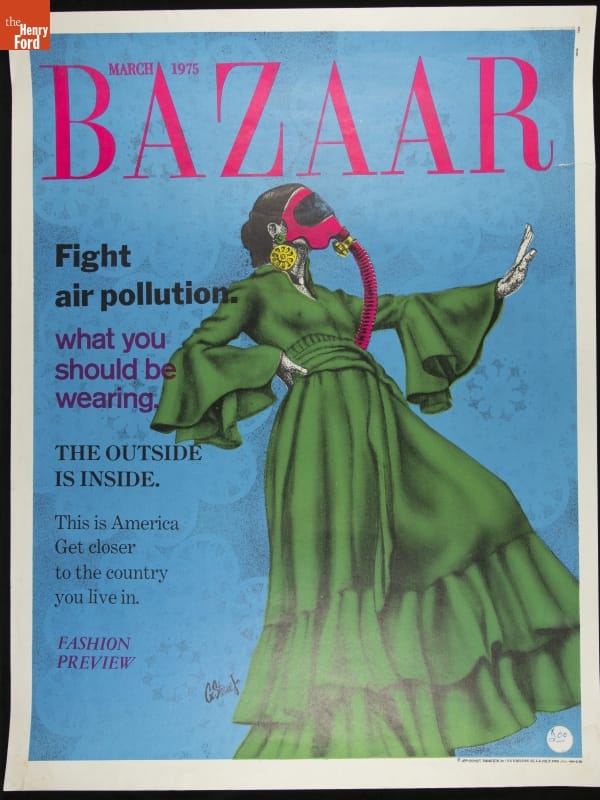
“March 1975, Bazaar, Fight Air Pollution, What You Should Be Wearing,” Poster, 1970. THF288328
This 1970 poster envisioned high fashion of the future, complete with a gas mask accessory. The moral of the story? Self-protection would not solve the problem of environmental pollution.
The Clean Air Act of 1970 empowered states and the national government to reduce emissions through regulation. This applied to industrial emissions as well as mobile sources (trains, planes, and automobiles, among others).
Interest in Recycling Grows
Poster by Eli Leon for Ecology Action, “Recycle” 1971. THF284835
Recycling emerged as a natural outgrowth of Earth Day, but local efforts could not succeed without explanation. First, consumers had to be convinced to save their newspapers, bottles, and cans, and then to make the extra effort to drop them off at centralized locations. This flyer showed how every-day consumer activity (grocery shopping) contributed to deforestation, littering, and garbage pile-up. Everybody could participate in the solution – recycling.
Recycling cost money, and this caused communities to balance what was good for the Earth, acceptable to residents, and possible within available operating funds. Even if customers voluntarily recycled, it still cost money to store recyclables and to sell the post-consumer materials to buyers.
Recycling Bin, Designed for Use in University City, Missouri, 1973. THF181540
City officials and residents in University City, Missouri, started curbside newspaper recycling in 1973, one of the first in the country to do so. Some argued that the city lost money because the investment in staff and trucks to haul materials cost more than the city earned from the sale, but saving the planet, not profit, motivated the effort. Eight years into the program, in 1981, city officials estimated that newspaper recycling kept 85,000 trees from the paper mill.
Easter Greeting Card, "Happy Easter," 1989-1990. THF114178
Today, more than 1/3 of post-consumer waste, by weight, is paper. Processing requires energy & chemicals, but recycled paper uses less water and produces less air pollution than making new paper from wood pulp. Maybe you buy greeting cards of 100% recycled paper, like this late 1980s example from our digital collections.
Environmentalism and Vegetable Gardening
Awareness of environmental issues affected the habits and actions of gardeners. Home gardening became an act of self-preservation in the context of Earth Day and environmentalism.
Lyman P. Wood founded Gardens for All in 1971, and the association conducted its first Gallup poll of a representative sample of American gardeners in 1973. It helped document the actions of gardeners, those proactive subscribers to new serials such as Mother Earth News. It confirmed their demographics and their economic investment.
Mother Earth News, 1970. THF290238
Raising vegetables using organic or natural fertilizers and traditional pest control methods became an act of resistance to increased use of synthetic chemical applications as concern about residual effects on human health increased.
How to Grow Vegetables and Fruits by the Organic Method, 1971. THF145272
Interest in organic methods remains high as concern about genetic-engineered foods polarizes consumers. The U.S. Department of Agriculture defines biotechnology broadly. The definition includes plants that result from selective breeding and hybridization, as practiced by Luther Burbank, among others, as well as genetic modification accomplished by inserting foreign DNA/RNA into plant cells. This last became commercially viable only after 1987. These definitions affect seed marketing, as this “organic” Burbank Tomato (not genetically engineered) indicates.
Charles C. Hart Seed Company “Burbank Slicing Tomato” Seed Packet, circa 2018. THF276144
What Gardening Means Today
Gardening as an act of personal autonomy
"Assuming Financial Risk," Clip from Interview with Melvin Parson, April 5, 2019. THF295329
Social justice entrepreneurs believe gardens and gardening can change lives. Learn about the work of Melvin Parson, the Spring 2019 William Davidson Foundation Entrepreneur in Residence at The Henry Ford, in this expert set. You can also learn more from Will Allen in an interview in our Visionaries on Innovation series.
Environmentalism
The 1970 “The Age of Conservation” has changed with the times, but individual acts and world-wide efforts still sustain efforts to “Give the Earth a Chance.” You can learn more about environmentalism over the decades by viewing artifacts here.
To read more about Adam Rome and The Genius of Earth Day: How a 1970 Teach-In Unexpectedly Made the First Green Generation (2013), take a look at this site.
Debra A. Reid is Curator of Agriculture and the Environment at The Henry Ford. This post came from a Twitter chat hosted in celebration of Earth Day 2020.
20th century, 1970s, nature, gardening, environmentalism, by Debra A. Reid, #THFCuratorChat
 Members of the Woman's National Farm and Garden Association, 1918. THF288950
Most Americans rely on grocery stores today. Few remember the time when there was constant demand on people to produce and preserve the grain, vegetables and meat they needed to feed themselves.
Over the last few weeks, self-isolation and social distancing have brought into sharp focus the need to plan for your next meal. Do you do it yourself, heading to your cellar to extract the last potatoes or turnips from the bins, or lift the lid off the sauerkraut crock, or pull down a cured ham from the rafters? Probably not. Do you head to the local market or the grocery store and stock up on fresh supplies to see you through for a few days? Or do you dig into the back of your cupboard and pull out a boxed mix or canned goods.
There’s never been a greater time to be resourceful than now. Last week, we donated food from The Henry Ford’s restaurants and cafeteria to Forgotten Harvest to help support our community after our campus closed this month because of COVID-19.
Looking for inspiration to be resourceful in your kitchen? We've dipped into resources and stories from The Henry Ford's collections to try to help. Explore the differences between home cooking and food resourcefulness today and in the past — from farm fresh and family raised to preserved and prepackaged. These digital resources will help you find inspiration whether it’s breakfast, lunch or dinner. Sort through recipe books, dig out that potato — is it a Burbank?! — and season with that essential preservative, salt, reflect and enjoy.
What are you doing in your kitchens right now to make the most of what’s in your cabinets? Share your examples of resourcefulness by tagging your photos and ideas with #WeAreInnovationNation.
Resilient Foods, Resourceful People
Women and the Land: Agricultural Organizations of WWI
Freedom from Want
Mattox Home
Staples
A Versatile Ingredient (Salt)
What If A Potato Could Change the World of Agriculture?
Summer Staples: Tomato and Corn
Eggs
Eggs (as seen on The Henry Ford’s Innovation Nation)
Historic Recipe Bank
Bread & Biscuits
Preservation & Processing Foods
Henry J. Heinz: His Recipe for Success
Canning
Refrigerators
Fresh Paper (as seen on The Henry Ford’s Innovation Nation)
Supply Chains
Horse-Drawn Deliveries
Lunch Wagons: The Business of Mobile Food
Tri-Motor Flying Grocery Store
Alternative Eating & Home Cooking
Farmbot
Food Huggers (as seen on The Henry Ford’s Innovation Nation)
Individual Artifacts
Swanson Frozen Dinners, 1967
Waffle Iron
Victory Gardens
Macaroni
Bean Pot
Debra A. Reid is Curator of Agriculture and the Environment. Did you find this content useful? Consider making a gift to The Henry Ford.
COVID 19 impact, by Debra A. Reid, agriculture, philanthropy, food